Finance recruiting, explained by a practitioner.
Clear, current guides on how finance recruiting actually works, from PE timelines to stock pitch structure. Written to answer the questions candidates actually ask.

Biotech Valuation: rNPV, Launch Curves and the Sum of the Parts
A company with no earnings is valued on what its pipeline would earn if it worked, weighted by the chance that it does.
Read guide
SaaS Operating Models: ARR, Sales Capacity, Billings and the Metrics That Follow
A subscription business is a stock moved by flows, sold by a team with a capacity, and paid for before it is delivered.
Read guide
How to Get Into Venture Capital
There is no application window, no assessment centre and no modelling test. There is a partnership deciding whether you can find companies before other people do.
Read guideCap Tables, Dilution and the Option Pool
Every term that sounds like a price is an instruction about this table. Learn to redraw it by hand and most of the technical questions in a venture interview answer themselves.
Read guideLiquidation Preferences and Preferred Stock, Explained
Ownership is a fraction. A preference is a choice. Every instrument a venture investor holds is a different rule for making it, and the exit value decides which way it goes.
Read guideSAFEs, Convertible Notes and Their Equivalents
Before the first priced round there is no price. These are the instruments that let money in anyway, and each one is a different answer to the same question: what is the early investor paid for the risk?
Read guide
Investment Banking Networking: The Full Campaign
Networking is not a personality test. It is a campaign with a list, a script and a follow-up schedule, and it can be run by someone who finds it uncomfortable.
Read guideInvestment Banking Behavioural Questions and How to Answer Them
Technicals decide whether you are safe to put in front of a client. Fit decides whether anyone wants to sit next to you at two in the morning.
Read guideBulge Bracket, Elite Boutique and Middle Market: How the Industry Is Tiered
The tiers are real, they describe different businesses, and the best one for you depends on what you want the analyst years to teach you.
Read guideValuation: How the Methods Fit Together
Three methods, one question. Learning them separately is why candidates can build a DCF and still cannot say what a company is worth.
Read guidePrecedent Transactions: Building the Analysis Properly
Comparable companies tell you what the market pays for a share. Precedents tell you what a buyer paid to own the whole thing, which is a different number for good reasons.
Read guideThe IPO Process, End to End
An initial public offering is a financing, a governance change and a marketing exercise happening at once, and the price is decided in the last forty-eight hours.
Read guideFinancial Statement Analysis: Reading a Company Properly
Anyone can pull a margin from a filing. The skill is knowing which three numbers in this company explain the other forty.
Read guideInvestment Banking Recruiting Outside New York and London
Almost all the advice available is written for two cities. The other hubs hire on different timelines, with different language requirements and much smaller classes.
Read guide
How Private Equity Actually Works
Before the modelling test there is a business model, and almost every technical question in a private equity interview is a consequence of it.
Read guideWhat a Buyout Fund Looks For in a Company
The modelling test tells a fund whether you can build. This tells it whether you can pick, which is the part that is hard to teach.
Read guideThe Private Equity Deal Process, Teaser to Signing
An associate spends most of the year on deals that do not happen. Knowing the sequence is how you understand which work matters and when.
Read guideThe Five Years After the Deal: Value Creation and Exit
Signing is the beginning. Everything that determines the return happens in the years nobody asks about in an interview.
Read guideInside a Private Equity Firm: Roles, Hierarchy and the Associate Job
A fund with twelve billion under management may have forty investment professionals. Small teams make the job different from banking in ways nobody explains.
Read guide
Hedge Fund Strategies, and What Each One Is Betting On
The label on the fund tells you what it is exposed to, how it is paid and what it will ask you in an interview. Applying without knowing which is a wasted round.
Read guideHedge Fund Careers: The Roles and How People Get Them
The job everyone applies for is one of about six, and the path to running money is shorter and less forgiving than anywhere else in finance.
Read guideWhere Investment Ideas Come From
The candidates who struggle in buy-side interviews are rarely the ones who cannot analyse a company. They are the ones with nothing to analyse.
Read guideBuilding an Investment Thesis
A thesis is not a description of a company. It is a claim about where consensus is wrong, and what will make that visible.
Read guideHow to Build and Pitch a Short
Everything about a short is asymmetric: the payoff, the time pressure, the cost of being early. Funds ask for one because it is where sloppy thinking shows.
Read guideThe One-Page Investment Write-Up
A portfolio manager reads the first four lines and decides whether to read the rest. Everything about the format follows from that.
Read guideThe Hedge Fund Case Study Round
Given a company and three days, most candidates produce a model. The ones who get offers produce a decision.
Read guide
What a Quantitative Fund Actually Does
A discretionary fund makes decisions about companies. A systematic fund makes decisions about decision rules, and then lets them run.
Read guideQuantitative Trading Strategies, Explained
The strategies differ mostly in one variable, which is how long a position is held. Everything else follows from that.
Read guideQuant Researcher, Quant Trader, Quant Developer: Three Different Jobs
One label, three jobs, three interview processes. Preparing for the wrong one is the most common way a strong candidate fails.
Read guideQuant Recruiting: Timelines, Process and What Firms Screen For
The process is shorter, more technical and less forgiving than banking recruiting, and almost none of the standard advice applies to it.
Read guideThe Maths a Quant Interview Actually Tests
The required syllabus is narrower than the rumours and deeper than a first course. Knowing which parts are load-bearing saves months.
Read guide
What Management Consulting Actually Is
The job is easy to describe and hard to picture. A client has a decision to make, and buys a team to make it better.
Read guideThe Consulting Industry: How It Is Structured and How It Earns
The economics explain the career. Understand the pyramid and the billing model, and up-or-out, the hours and the hiring volumes all stop being mysterious.
Read guideThe Consulting Firms, and How They Differ
The tiers are real and they are not a ranking of quality. They describe different businesses with different work, different clients and different lives.
Read guideThe Consulting Career Path, Analyst to Partner
The ladder is unusually explicit and unusually short at the top. Most people are meant to leave, and the industry is built around that.
Read guideConsulting Recruiting: The Cycle and How to Run It
The internship is the main door and it is decided a year before the job starts. Almost everything else is a smaller door.
Read guideThe Consulting CV and Cover Letter
A consulting CV is read for evidence of four things. Everything on the page either provides that evidence or takes up room.
Read guideThe Consulting Interview Process, Round by Round
Two interviews, each half case and half conversation, repeated with more senior people. The format is stable and the scoring is less mysterious than it looks.
Read guideConsulting Fit Questions and the Personal Experience Interview
The case decides whether you can do the work. The fit interview decides whether anyone wants you on their team for eight weeks in a hotel.
Read guideThe Case Interview, End to End
A case is a twenty-five minute simulation of a ten-week project. Everything being assessed is visible in how you spend the first three minutes.
Read guideCase Interview Frameworks, and Why Memorising Them Fails
Interviewers have heard every standard framework several thousand times. What they are listening for is whether yours was built for this problem.
Read guideThe Case Types, and How Each One Is Solved
There are about eight case types and they recur constantly. Recognising which one you are in gives you thirty seconds of structure you did not have to invent.
Read guideMarket Sizing and Estimation Questions
Nobody expects the right number. They expect a defensible path to a number, stated out loud, with the arithmetic done correctly.
Read guideCase Interview Maths and Brainteasers
Nobody fails for being slow at multiplication. People fail for dropping a zero and not noticing, which is a different problem with a different fix.
Read guideConsulting Online Assessments and Digital Cases
The first cut is now made by software, and it filters more candidates than any interview. It is also the stage almost nobody prepares for.
Read guidePrivate Equity vs Venture Capital: What Each One Is Actually Buying
Both buy private companies. Almost nothing else about the two jobs is the same, and the reason is what each one is underwriting.
Read guide
How Options Work: Calls, Puts, Payoffs and the First Greek
One right, one obligation, and a premium paid up front. Almost every option question is an argument about those three things.
Read guide
Stocks and Bonds, and Why the Difference Decides Everything
One makes you an owner and one makes you a lender. Every other difference is a consequence of that.
Read guideWhat an Investment Bank Actually Does
The business model first, then the divisions, then where a graduate job actually sits inside them.
Read guideWhat a Hedge Fund Actually Does
The word does real work. Start there, then the fees, then the strategies, then the job.
Read guideHedge Funds and Mutual Funds, Side by Side
Both pool money and buy securities. Almost everything after that is different, and the benchmark is the difference that matters.
Read guideWhat an Investment Banking Analyst Actually Does All Day
Not the brochure version. The four things you produce, when they arrive, and why the evening is the part nobody describes.
Read guide
Investment Banking Cover Letters: Advisory and Capital Markets
For M&A, coverage, ECM, DCM, leveraged finance and restructuring seats. It gets thirty seconds, if that. Here is what to do with them.
Read guide
Corporate and Commercial Banking Cover Letters
Not the investment banking letter with the division swapped. Corporate and commercial banking is a lending and relationship business, and the paragraph that proves you understand it is a different paragraph.
Read guideHow to Learn a Technical Topic From Video
Ten deliberate minutes usually beat forty-five at 1.5x speed. Here is the difference, and how to run it.
Read guideThe Revision Loop That Survives Three Weeks
Most revision fades within a fortnight. Four stages, six prompts, and about forty minutes a topic change that.
Read guideEverything That Works Feels Wrong
The best ways to study often feel worse while you are doing them. That explains a surprising amount of what goes wrong with revision.
Read guideThe Investment Banking Career Path, Rung by Rung
What each level does all day, how long it takes to leave it, and where the people who leave go instead.
Read guide
The 2027 Investment Banking Recruiting Timeline
Several calendars occupy the same year. The expensive mistake is following the wrong one.
Read guide
Analyst to Associate: The Promotion, and Whether to Take It
The offer arrives wrapped as a reward. It is one. It is also a career decision, and those are not the same thing.
Read guide
How to Become an Investment Banker: Applications and Interviews, Start to Offer
The pillar guide to investment banking recruiting: which route is yours, what each stage filters on, and how to prepare for the stage you are at.
Read guideSoftware Engineering Interviews at Trading Firms and Banks
The algorithms round looks familiar. Almost everything around it is asking a different question.
Read guideData Science Interview Questions in Finance
The methods are the ones you already know. The constraints are what the interview is really about.
Read guideVenture Capital Interview Questions
The modelling is easier than banking. Almost everything else about the assessment is harder to fake.
Read guideCorporate Development Interview Questions
The same technical toolkit, pointed at one company forever, with nobody to hand the model to when it closes.
Read guideQuant Interview Questions: Trading, Research and Dev
Three different jobs share one label, and the interviews differ more than the job titles suggest.
Read guide
The US Answer to a Spring Week: Sophomore Insight Programs
They exist, they matter as much as a spring week does, and almost everything about the timing is different.
Read guideThe US Finance Resume: One Page, No Photo, GPA On It
The American format is stricter than the British one, and the differences are not stylistic — several of them will get your resume set aside.
Read guide
UK Spring Weeks: Timeline, Assessments, and How Offers Are Decided
When applications open, what is actually in the assessment at each bank, and how a week of work experience turns into a summer internship offer.
Read guideInvestment Banking Case Studies: Spring Week vs Analyst vs Associate
Four different exercises share one name. Preparing for the wrong one is the most common way candidates waste a month.
Read guide
Psychometric Tests for Finance: Numerical, SJT and Game-Based
Most candidates are rejected before a human sees their application. This is the stage that does it.
Read guideThe Finance CV: One Page That Survives a 30-Second Skim
A screener gives it half a minute. Every choice on the page should be made with that fact in mind.
Read guide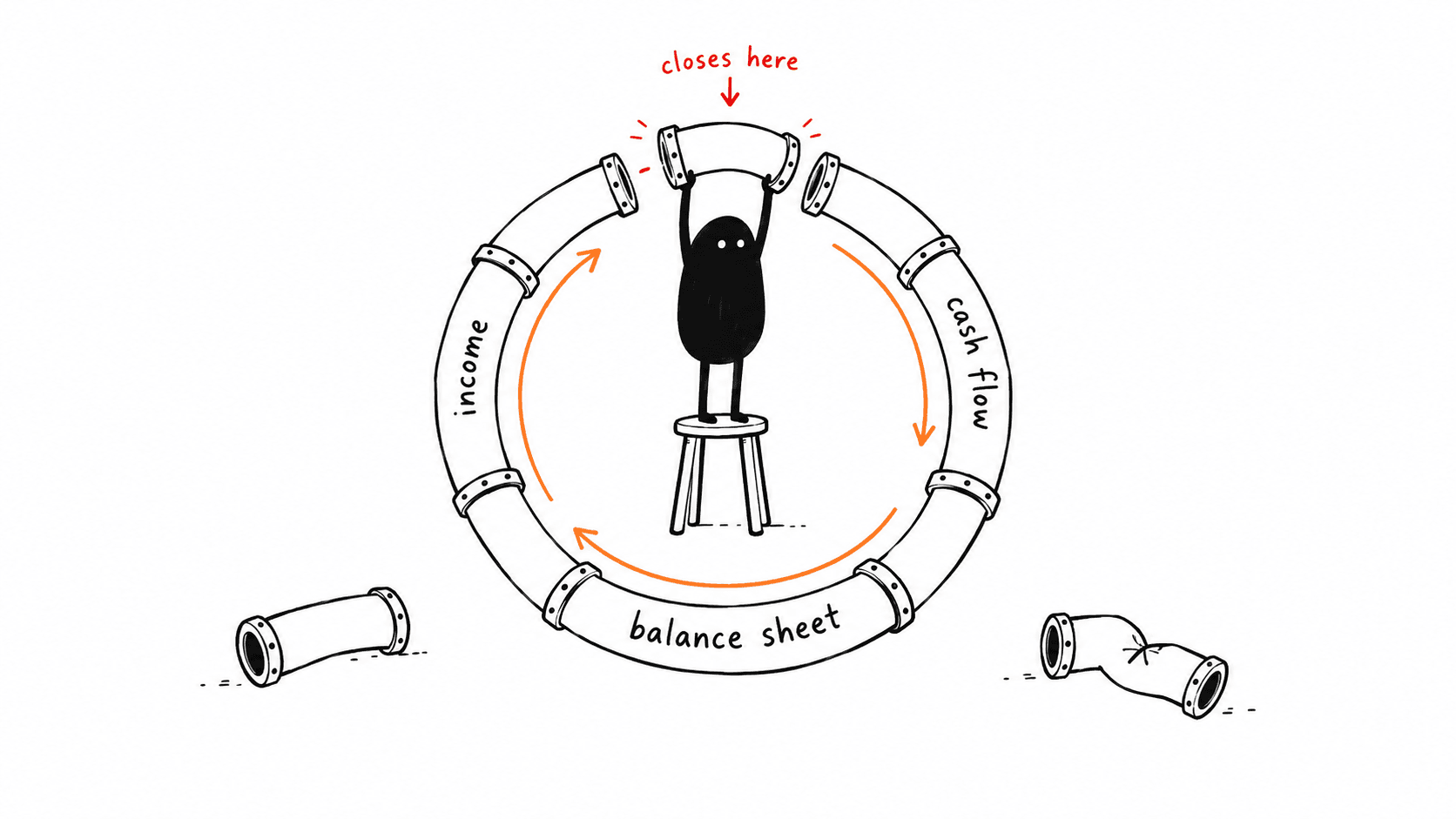
Financial Modelling Best Practices: The Conventions That Make a Model Auditable
A model is a document other people have to read. These are the conventions that make that possible.
Read guideHow to Build a Three-Statement Model That Actually Balances
The build order matters more than the formulas. Get the sequence right and it balances on the first try.
Read guideHow to Build a DCF Model: Build Order, Terminal Value and the Sanity Checks
A DCF is 70% terminal value and 100% assumptions. Build it so both can be defended.
Read guide
How to Build an LBO Model: The Build Order That Survives a Modelling Test
Under a 90-minute clock, the build order is the difference between a returns number and a half-finished model.
Read guideHow to Review a Financial Model Before It Leaves Your Desk
Reading through a model looking for what seems wrong is not a review. This is what one actually looks like.
Read guideHow to Build a Merger Model: Purchase Accounting, Financing and Accretion
The accretion number is easy. Everything that produces it is where models go wrong.
Read guideWorking Capital and Quality of Earnings: Where Deal Value Actually Moves
The headline price is agreed early. Working capital and QoE decide what actually gets wired.
Read guideCredit and Covenant Modelling: What a Lender Actually Tests
A sponsor models the upside. A lender models the case where it goes wrong. Both live in the same file.
Read guideScenario and Sensitivity Architecture: Building a Model That Can Be Stress-Tested
Anyone can change an assumption. Architecture is what lets someone else change it safely.
Read guideReal Estate Financial Modelling: Why Corporate Finance Mechanics Break Here
The Excel mechanics are the same. The economic logic is not, and that is what catches people.
Read guide
Project Finance Modelling: Cash Flow Waterfalls, DSCR Sizing and the Debt Sculpt
No corporate balance sheet stands behind the debt. The cash flow waterfall is the entire credit.
Read guideBulge Bracket vs. Boutique Superday: What Actually Differs
Same day, same format on paper — different people in the room, and a different thing being tested.
Read guide"Tell Me About Yourself" in Investment Banking Interviews
The first ninety seconds of the interview, and the one answer nearly every candidate under-prepares.
Read guideDCF Interview Questions: The Ones That Actually Come Up
From "walk me through a DCF" to the follow-ups that catch people who only memorised the steps.
Read guideComparable Companies (Comps) Interview Questions
Picking the comp set, choosing the right multiple, and the follow-ups that expose a memorised answer.
Read guide"Why This Bank?" — Building an Answer That Isn't Generic
Interviewers hear the same three generic answers all day. Here is how to not be the fourth.
Read guideM&A Interview Questions: Accretion/Dilution and Beyond
The accretion/dilution shortcuts, the cash-vs-stock logic, and the follow-ups that separate memorised from understood.
Read guide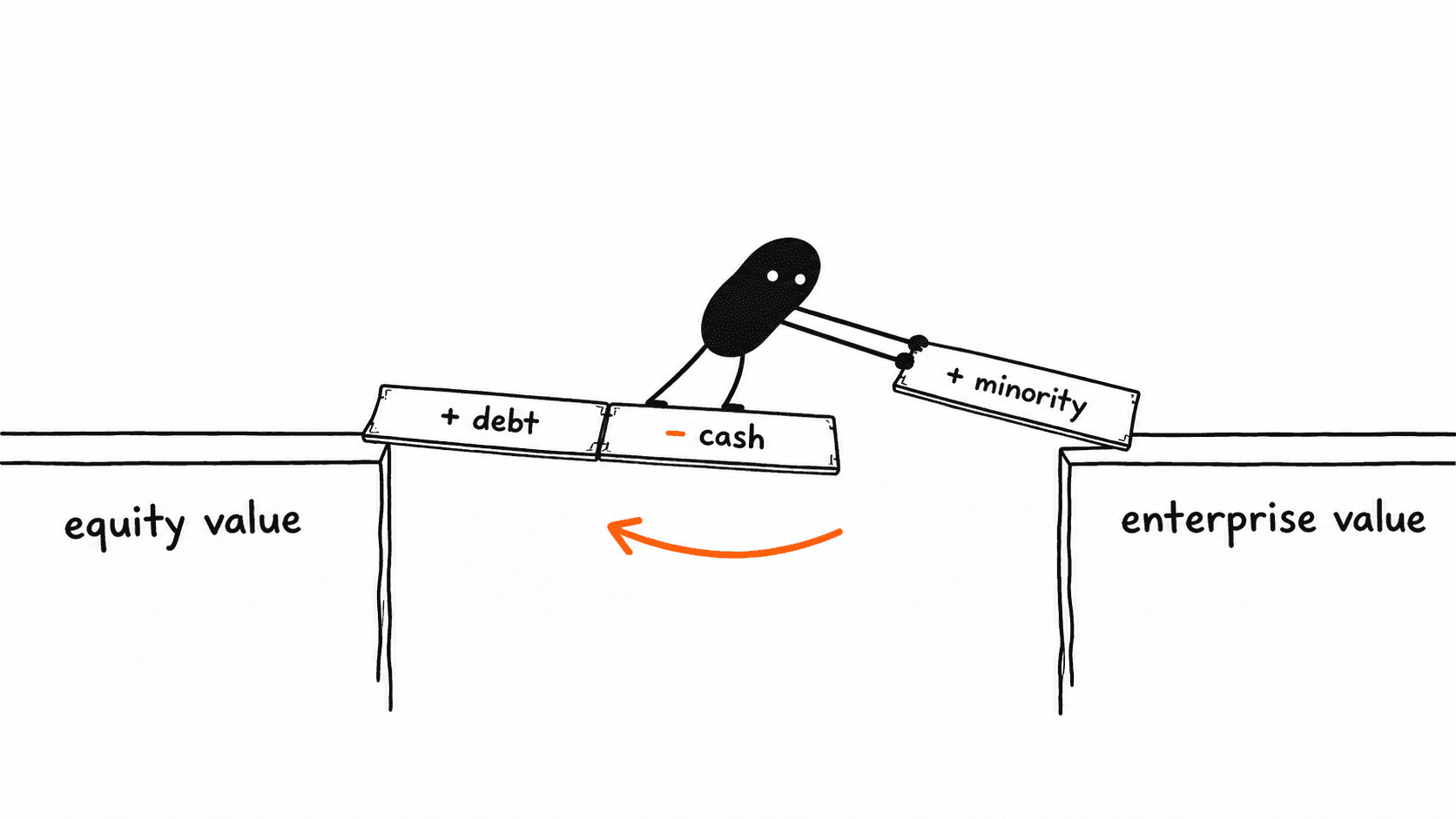
Enterprise Value vs. Equity Value, Once and For All
The most-asked valuation concept in finance interviews, and the bridge, pairing rules, and follow-up traps that come with it.
Read guideOff-Cycle PE Outreach: The Emails That Actually Get Replies
Off-cycle roles are filled through inboxes, not job boards. Here is what to put in them.
Read guideLBO Interview Questions: The Conceptual Ones Behind the Maths
The paper LBO tests your arithmetic. These questions test whether you understand the machine.
Read guide"Walk Me Through the Three Statements" — And Every Follow-Up
The most-asked accounting question in finance interviews, and the $10 depreciation follow-up that comes with it.
Read guide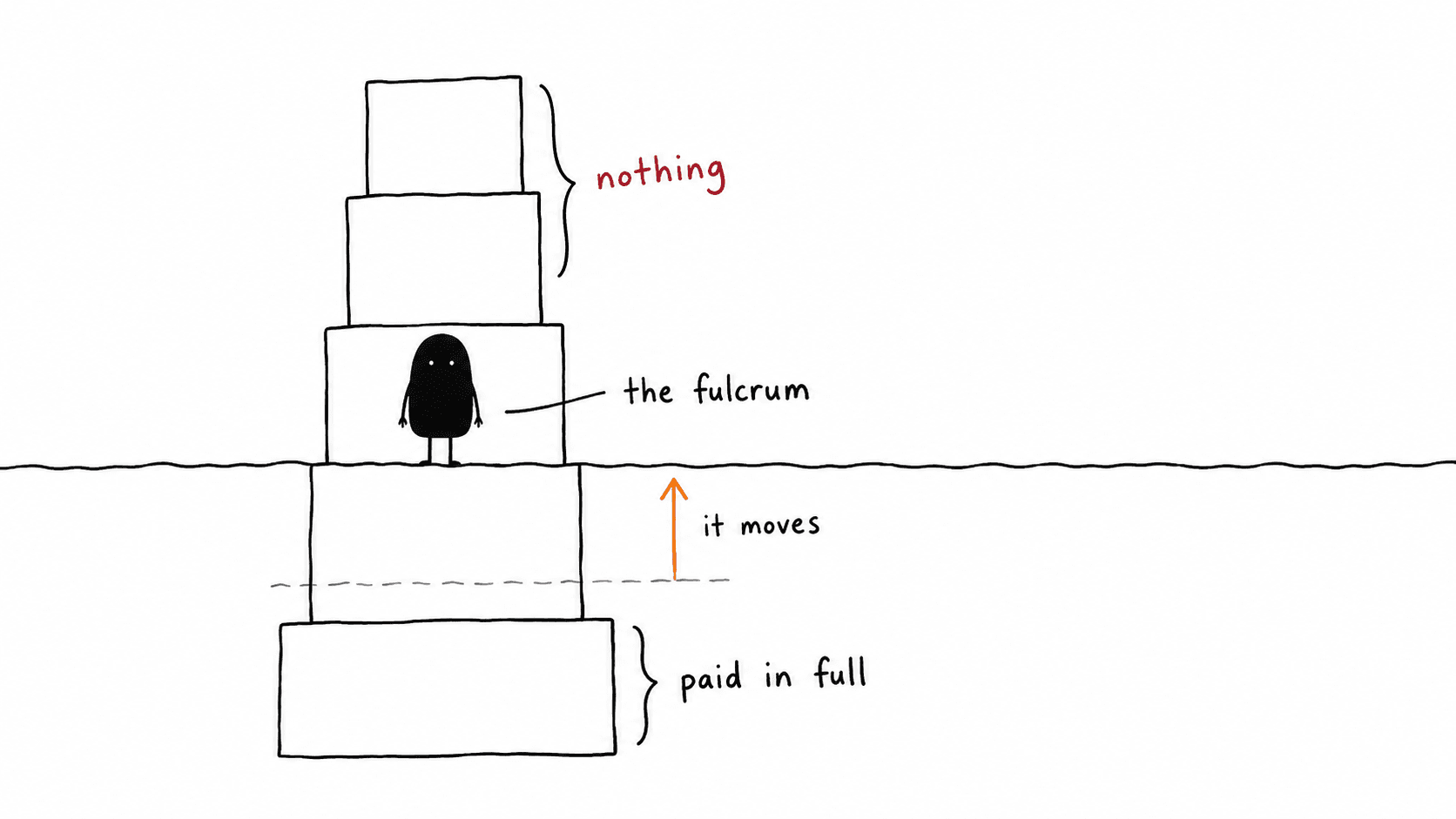
Restructuring Interview Questions: Fulcrum, Waterfall & Beyond
RX interviews add a layer on top of standard technicals: capital structure under stress. Here is that layer.
Read guideSales & Trading Interviews: What Actually Gets Tested
S&T interviews are not IB interviews with different logos. Different skills, different questions, different prep.
Read guideUK Assessment Centres: The Full Day, Stage by Stage
The final round of most UK spring week, internship and graduate processes, and the stage candidates prepare for least.
Read guideEquity Research Interview Questions: The Coverage Mindset
ER interviews test whether you think like a coverage analyst: estimates, calls, and what changes them.
Read guide
Hedge Fund Interview Questions Beyond the Stock Pitch
The pitch gets you in the room. These are the questions that decide what happens next.
Read guideFinance Networking Emails: Templates That Get Answered
Bankers answer a predictable kind of email and archive everything else. Here is the predictable kind.
Read guidePrivate Equity On-Cycle Recruiting Timeline (2026-27)
What actually happened in January 2026, how the headhunters work, and how far ahead you need to be ready.
Read guidePaper LBO Example: A Full Walkthrough, Step by Step
The exact sequence to run in your head, a fully worked example, and the shortcuts that make the maths fast under pressure.
Read guideInvestment Banking Superday: How It Works and How to Prepare
The format, the interviewer mix, what each round is really testing, and the 48-hour preparation plan.
Read guideHow to Answer "Why Private Equity?" (With Frameworks and Examples)
The three-part framework, what strong and weak answers sound like, and the follow-ups that catch memorised scripts.
Read guide
Top Investment Banking Technical Questions (With Answer Frameworks)
The questions that actually get asked, the frameworks to answer them, and the traps inside each one.
Read guide
The Private Equity Modelling Test: What to Expect and How to Prepare
The formats by fund type, what graders open first, and a two-week preparation plan that actually fits around a banking job.
Read guide
Goldman Sachs HireVue: Question Types, Format and How to Prepare
The format, the question mix, how the AI screen actually grades you, and a preparation plan that beats a canned script.
Read guideOff-Cycle Private Equity Recruiting in the US
The continuous, proactive path to a buyside seat that most candidates underuse.
Read guideHedge Fund Stock Pitch Template and Framework
The structure PMs actually evaluate, from thesis to risk, with the variant perception that wins.
Read guide
Spring Week vs Summer Internship vs Industrial Placement
Which early finance programme is which, who each is for, and how they ladder into a full-time offer.
Read guideLooking for curated external resources? See the reading list
Read the guide. Then go and be asked about it.
Guides give you the map. A discovery session tells you where you actually are on it, and the bootcamps get you the rest of the way.