Investment banking recruiting has a timing problem disguised as an application problem. Candidates assume the process begins when a bank posts a role. By then, stronger applicants have often spoken to people at the firm, prepared their technicals and built a version of their CV for that programme. There is no single banking calendar. There are several occupying the same year, and following the wrong one costs a cycle.
First, work out which calendar is yours
Before noting a single deadline, answer three questions: where are you applying, when do you graduate, and which programme are you actually eligible for. The same candidate can be early, on time and too late on the same day, depending on which of the three you mean.
The careers page tells you whether you may apply. The process tells you whether you are still competitive. Those are different questions and only one of them is published.
| Track | Typical candidate | What it is for |
|---|---|---|
| UK spring week | First year of a three-year degree, or second of four | Early insight, and a route into the following summer |
| UK summer internship | Penultimate year | The main conversion route into a 2028 graduate seat |
| UK graduate programme | Final year or recent graduate | Direct entry into a 2027 analyst class |
| US summer analyst | Graduating the year after the internship | The main conversion route into full-time banking |
| US full-time analyst | Final year, after intern conversion | The seats the intern class did not fill |
| Off-cycle internship | Anyone meeting local eligibility | Rolling entry outside the main summer class |
How the UK and US calendars differ
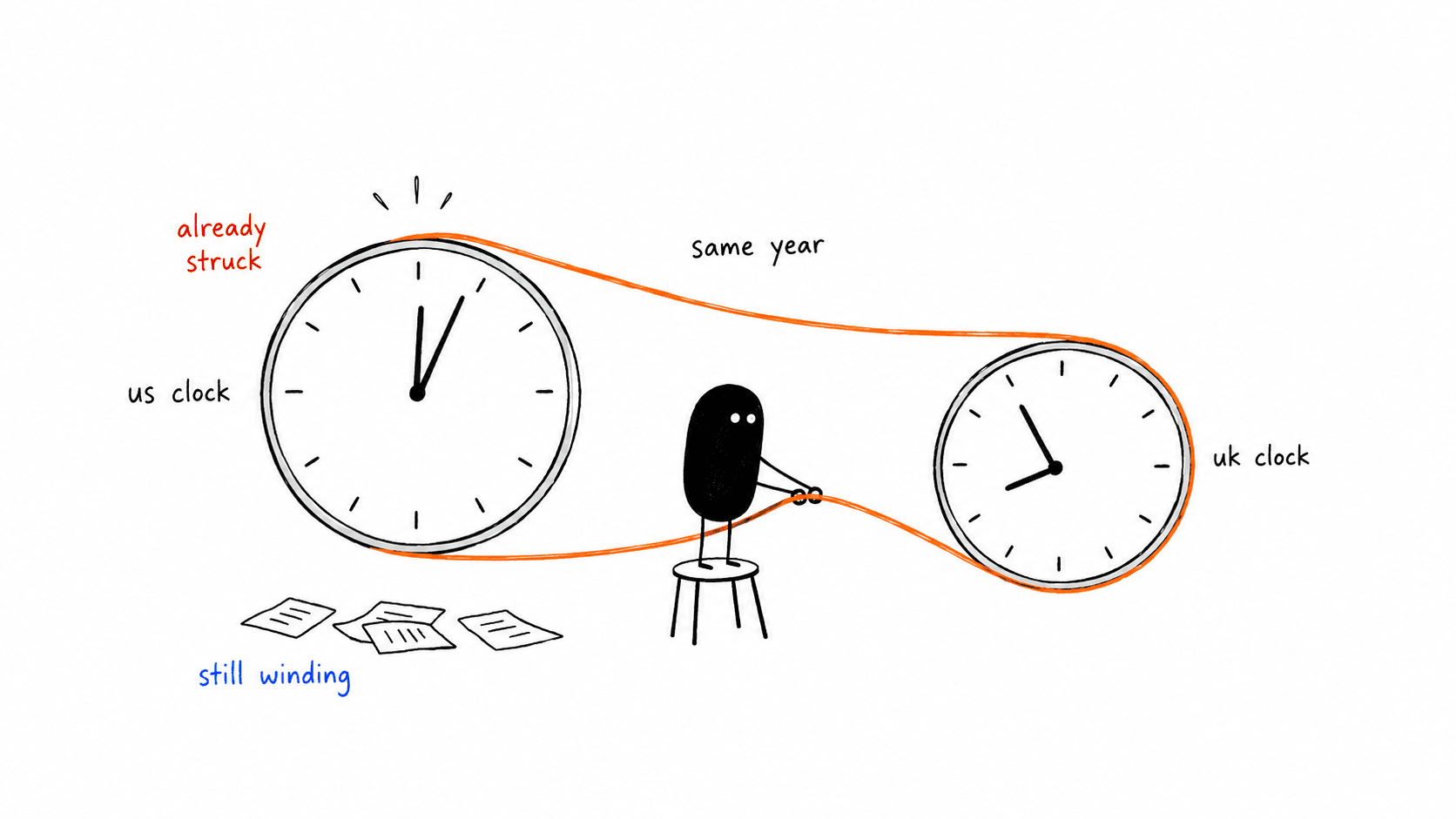
The difference is not a few weeks. For summer 2027, many large US processes ran applications and interviews through late 2025 and early 2026, while the equivalent UK windows open in the autumn of 2026. Copying a UK timeline into a US search can cost an entire cycle, because the programme title is the same and the clock is not.
Read the chart by finding the marker for today and looking left. Everything behind it has already happened for that track.
Planning ranges rather than promises. Individual banks open and close inside these windows, and several recruit on a rolling basis, which is the reason the windows are wide.
Where the 2027 cycle stands now
As of September 2026, UK recruiting for 2027 is moving into its main opening period, and the dates are firm-by-firm rather than sector-wide. Deutsche Bank listed its 2027 UK IBCM graduate window as 7 September to 11 October 2026. Jefferies listed 15 November for its London 2027 summer internship and said recruitment is rolling. Peel Hunt said its 2027 internship applications open at the start of October. Nomura listed 1 December for its London summer internship and encouraged early applications for the same reason.
Four firms, four different answers, one market. That is the argument for tracking roles individually rather than waiting for a common opening day that does not exist.
In the US, being late for the main cycle is not the same as there being no roles. It does mean the search changes shape: from following a calendar to finding live processes.
The UK year, month by month
June to August is the preparation window. By the end of it you want a reviewed one-page CV, a base cover letter that can be tailored without becoming a mail merge, answers for why banking and why this bank, test practice underway, and a tracker of target firms and dates. The portal opening should trigger submission work, not the beginning of self-discovery.
September to October is the main opening wave. Check live openings several times a week, submit promptly, record every deadline, and keep networking after applying rather than before. Applying on the first morning with the wrong division name is not an advantage: the target is early and checked.
November to December shifts from applications to assessments. Tests, situational judgement, game-based assessments, recorded video, first rounds. The common mistake is treating each invitation as an interruption to the application campaign. Once a bank has invited you, preparing for that stage is worth more than another generic application. Volume creates opportunities; conversion creates offers.
January to March is later processes and final rounds, and it is when spring week assessment centres become active. If your response rate has been weak, diagnose the stage rather than the market.
- No tests or first rounds points at the CV, eligibility or application quality.
- Tests but no interviews points at assessment performance.
- Interviews but no offers points at technical, behavioural or communication work.
- "Recruiting is competitive" may be true, and it is not a diagnosis.
What rolling actually means
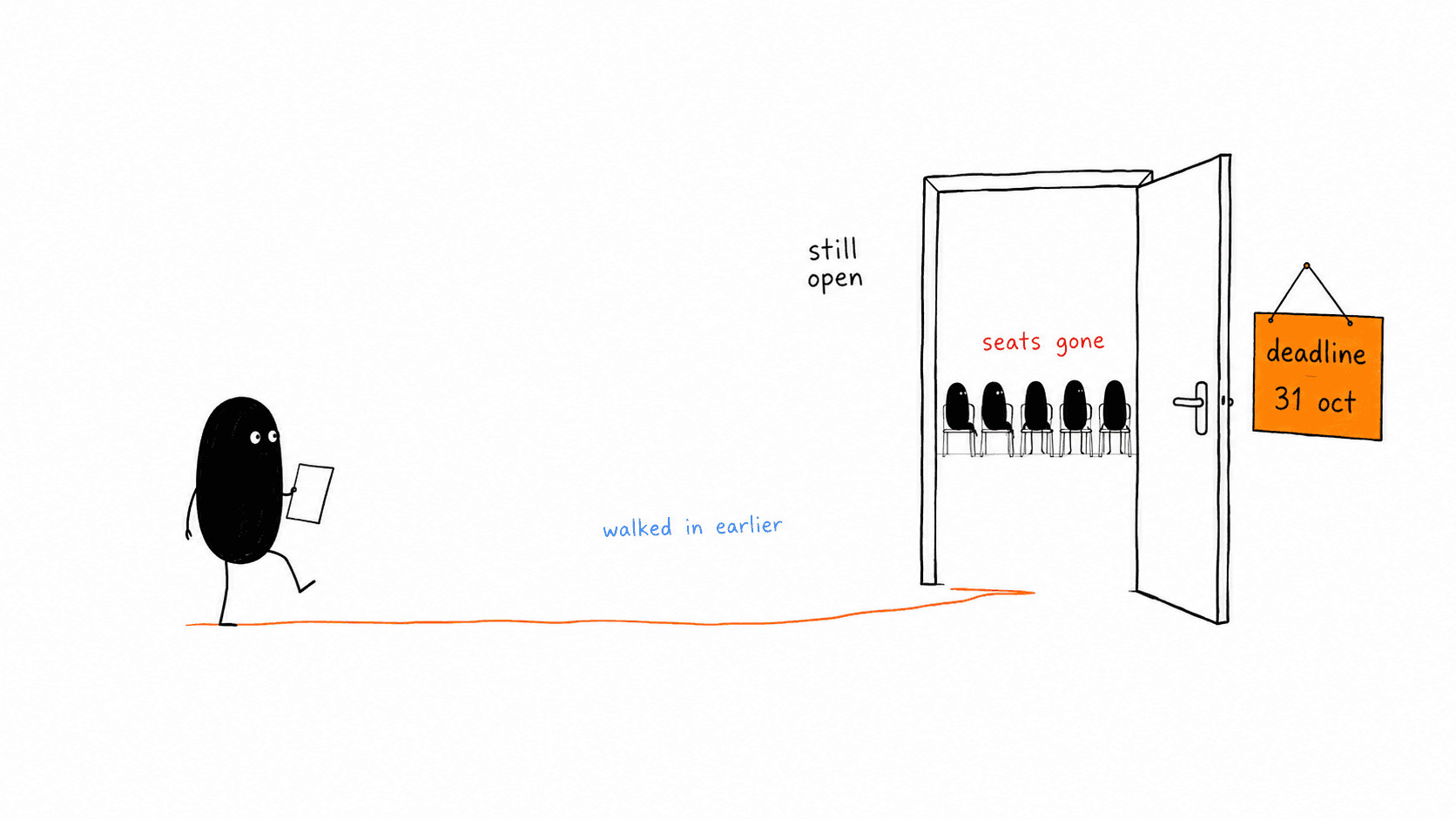
Rolling does not mean applications are read neatly in the order received. It means the bank can screen, test, interview and offer before the stated deadline.
By the closing date a process may be fully open, open for a handful of seats, building a reserve list, or accepting applications while earlier candidates sit at final round. You cannot tell which from the portal, and the portal is the only thing you can see.
The rational response is to apply early once the application is good enough, then prepare as though the next stage could arrive quickly. Early does not mean careless. Perfect does not mean submitted after the seats are gone.
Prepare one stage ahead of where you are
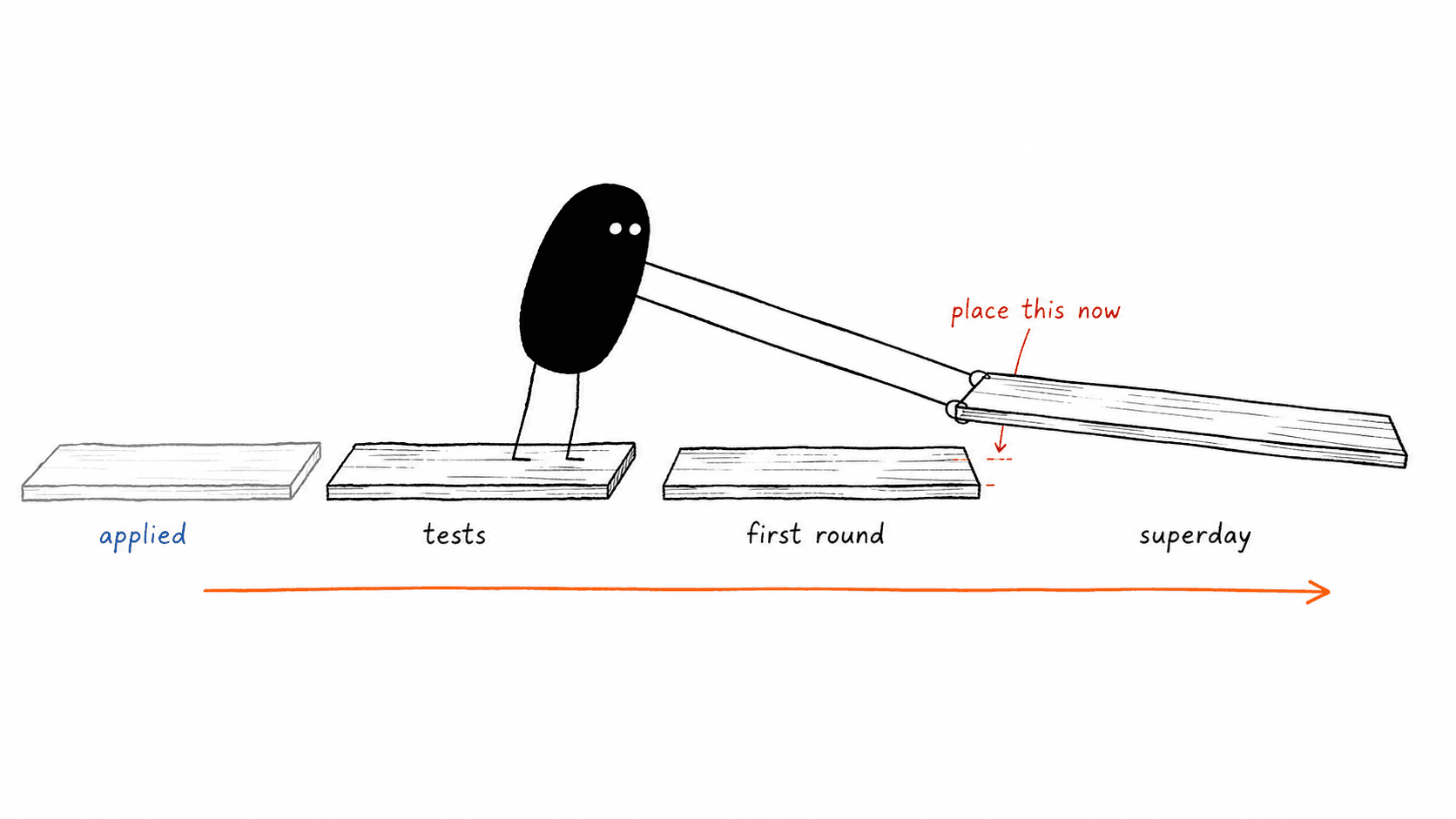
The useful way to read a timeline is backwards from the next likely decision rather than forwards from today. If you prepare only for the stage in front of you, every invitation arrives as an emergency.
| Where you are | What to prepare now |
|---|---|
| Roles not yet open | CV, core story, target list, networking |
| Applications open | Tailored applications, tests, recorded video answers |
| Tests underway | First-round behavioural and technical |
| First round booked | Superday depth, recent transactions, sharper firm knowledge |
| Offer secured | Internship readiness and the basics of the job |
If you missed the main window
Missing one route does not close the career. It does mean the next move should be based on where you are rather than the calendar you wish you had followed.
Choose the route that adds relevant evidence. A year spent building transaction, valuation, accounting or client experience is not automatically a lost year. The poor response to a missed cycle is random activity; the better one is asking what the next application needs to contain that the last one did not.
- Off-cycle internships in London and continental Europe, which run all year.
- Later-opening boutiques, regional firms and smaller offices where you have a credible location story.
- Graduate seats left after intern conversion.
- Big Four deals, valuation or transaction services as a route to a later move.
- A deliberate application in the next eligible cycle, rather than a rushed one now.
Frequently asked questions
When do 2027 investment banking applications open in the UK?
Many UK summer internship and graduate applications open between late summer and autumn 2026, with deadlines spread across the autumn and several processes recruiting on a rolling basis. Deutsche Bank, Jefferies, Peel Hunt and Nomura all published different 2027 dates, which is why a live tracker beats an assumed common opening day.
Is it too late to apply for a 2027 US summer analyst role?
It is late for many of the earliest large-bank processes by September 2026, and not necessarily for every bank, boutique, region or adjacent programme. Focus on firms confirmed to be actively reviewing and on those that have not yet posted, rather than treating every live application link as a live process.
Are investment banking deadlines rolling?
Many are. A rolling process can interview and make offers before the stated deadline, so a November closing date does not mean an application submitted in November gets the same consideration as one submitted in September.
Which year of university should I apply in?
Eligibility varies by programme and degree length. UK spring weeks generally target students early in a degree, summer internships target the penultimate year, and US summer analyst eligibility is usually framed around graduation year. Follow the wording of the specific programme rather than the general rule.
What happens after I submit an application?
The usual sequence is application, online assessments, a recorded video or first-round interview, then an assessment centre or Superday. Not every bank uses every stage and the order varies.
Should I apply the moment a role opens?
Apply early, but only after checking the application. A strong submission in the early part of a rolling window beats a rushed one on day one, and it certainly beats a perfect one sent after the process is effectively full.
Related guides
Investment Banking
UK Spring Weeks: Timeline, Assessments, and How Offers Are Decided
9 min read
Investment Banking
Spring Week vs Summer Internship vs Industrial Placement
6 min read
Investment Banking
Top Investment Banking Technical Questions (With Answer Frameworks)
10 min read
Investment Banking
The Investment Banking Career Path, Rung by Rung
9 min read
Want this applied to your recruiting?
Reading is the easy part. For practitioner feedback tailored to your situation, work 1:1 with Suro.