An integrated three-statement model is the foundation everything else sits on — a DCF, an LBO, a merger model and a credit analysis are all extensions of it. Most people learn it as a set of formulas and then spend years being confused about why it breaks. It is more usefully learned as a build order: a sequence in which each step has everything it needs from the steps before it. Follow the sequence and the balance sheet balances without a plug. Skip around and you will spend longer debugging than you did building.
Why the build order is the whole technique
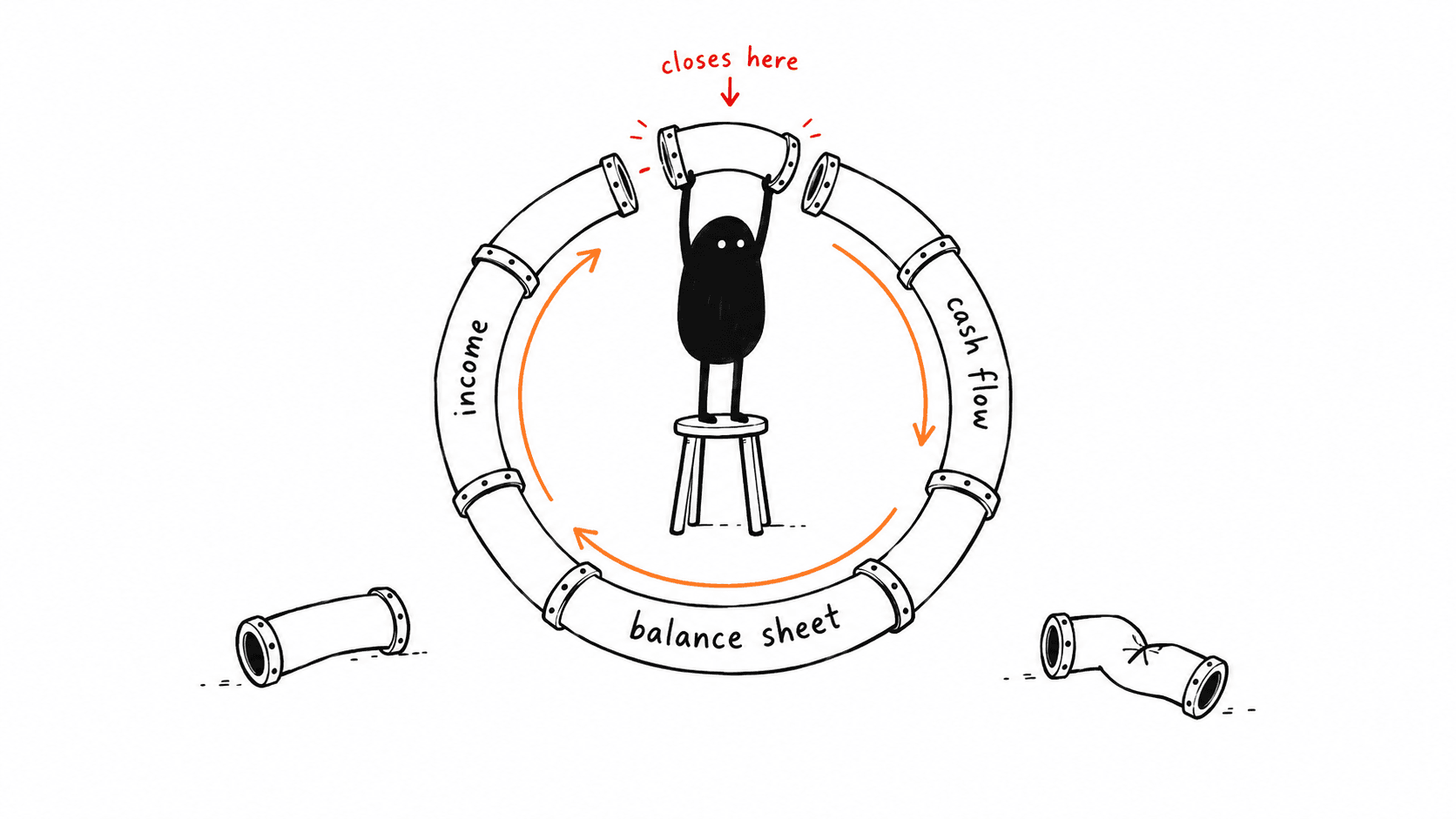
The three statements are a closed system. Net income flows from the income statement into retained earnings on the balance sheet and to the top of the cash flow statement. Closing cash from the cash flow statement becomes the balance sheet cash line. Every non-cash item and every balance sheet movement is an adjustment in between. If any one of those linkages is missing or double-counted, the balance sheet will not balance.
The reason build order matters is dependency. You cannot calculate interest expense until you have a debt schedule. You cannot build a debt schedule until you know cash flow before financing. You cannot know that until you have working capital and capital expenditure. So the sequence is forced, and fighting it is what causes the mess.
Step 1 — Historicals and the drivers behind them
Input three years of historical financials as hardcodes on a dedicated tab, then calculate the ratios that will become your forecast drivers: revenue growth, gross margin, operating expense as a percentage of revenue, days sales outstanding, days inventory outstanding, days payable outstanding, capital expenditure as a percentage of revenue, and the effective tax rate.
The point of this step is that your forecast assumptions should be visibly anchored to what the business has actually done. A reviewer asking "why 4% revenue growth?" should be able to see the three-year historical trend sitting directly above your assumption. Forecast drivers that appear from nowhere are the first thing diligence tests.
Do not skip the ratio calculation because you already know what you want to assume. The ratios are how you discover that the business you are modelling has margin behaviour you had not noticed.
Step 2 — Revenue and operating build
Build revenue from drivers rather than a growth percentage where the data allows: volume times price, subscribers times ARPU, stores times revenue per store. Driver-based revenue is dramatically more defensible under scrutiny, because each component can be challenged and tested separately, and because it forces you to hold a view about the business rather than about a number.
Project the cost lines with the fixed and variable split made explicit. A model that applies a flat margin percentage to a growing revenue line is implicitly assuming no operating leverage at all, which is almost never how a real business behaves. Separating fixed from variable is what makes the downside scenario meaningful — in a downturn, fixed costs are exactly what hurts.
Stop at EBIT. Interest cannot be calculated yet, because the debt schedule does not exist.
Step 3 — Working capital schedule
Model working capital from days assumptions, not as a percentage of revenue. Receivables equal DSO divided by 365 times revenue; inventory equals DIO divided by 365 times cost of goods sold; payables equal DPO divided by 365 times cost of goods sold.
The reason this matters beyond accuracy: days assumptions are challengeable and benchmarkable. A reviewer can ask whether 62 days receivable is consistent with the customer base and the sector, and that is a productive conversation. "Working capital is 12% of revenue" cannot be interrogated at all, which is why lenders push back on it.
The change in net working capital feeds the cash flow statement, and the closing balances feed the balance sheet. Both linkages, not one.
Step 4 — Fixed asset roll-forward
Opening property, plant and equipment, plus capital expenditure, less depreciation, equals closing PP&E. Simple, and routinely built wrong by depreciating the closing balance instead of the opening balance, or by forgetting that the depreciation figure has to appear in three places: as an expense on the income statement, as an add-back on the cash flow statement, and as a reduction in the roll-forward.
Where capital expenditure is material, split maintenance from growth. It changes the free cash flow conversation entirely, and it is the split that any credit or private equity reviewer will ask for.
Step 5 — The debt schedule and the cash sweep
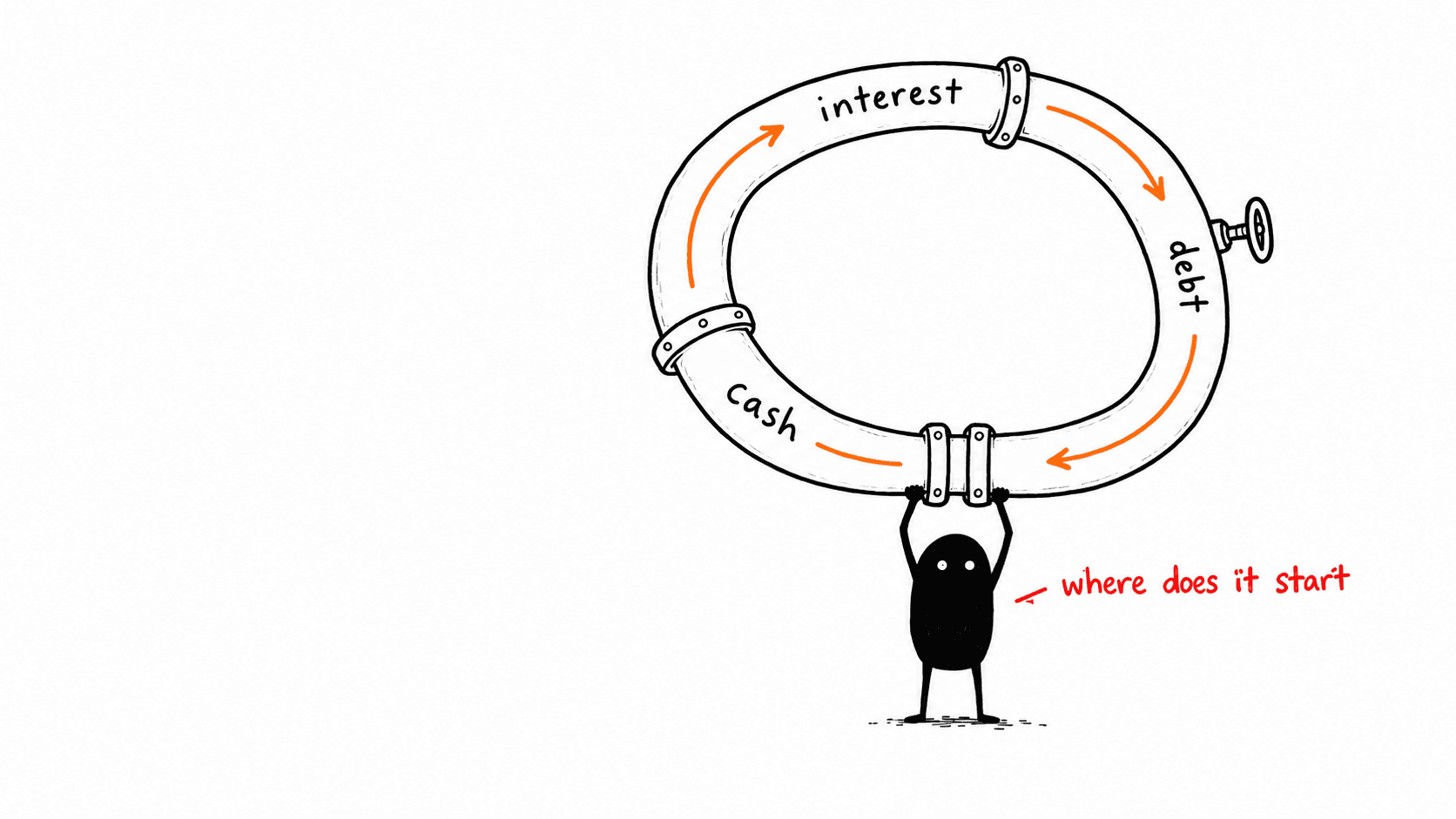
This is the step where the model becomes integrated, and where the circularity appears. The sequence within the schedule: start from cash flow available for debt service, apply mandatory amortisation, then apply any optional prepayment via the cash sweep, then draw on the revolver if the cash balance falls below its minimum.
Interest is calculated on the debt balances, but the debt balances depend on how much cash was available after interest. Resolve it one of two ways: enable iterative calculation with a labelled circuit-breaker toggle, or calculate interest on opening balances and accept the small imprecision. For a model that will be handed to other people, the second is usually the better trade.
Only now can you return to the income statement and populate interest expense, then earnings before tax, tax and net income.
- Cash available for debt service, before any repayment decisions.
- Mandatory amortisation first — it is contractual, not optional.
- Cash sweep second, respecting any minimum cash balance the business needs to operate.
- Revolver draw last, as the balancing item when cash would otherwise go below minimum.
- Interest on each tranche at its own rate, feeding back to the income statement.
Step 6 — Close the loop and check
Net income now flows to retained earnings and to the top of the cash flow statement. Add back depreciation and any other non-cash items, apply the change in working capital, subtract capital expenditure in investing, and put debt movements and any equity movements in financing. Closing cash flows to the balance sheet.
If it balances, you are done. If it does not, resist the urge to hunt randomly — there is a standard debugging sequence and it resolves the overwhelming majority of cases in a few minutes.
When it does not balance: the debugging sequence
Work in this order. Each step is cheaper than the one after it, and the first three catch most errors.

- Check the size of the imbalance. If it equals a line item you recognise, you have found it — that item is missing from one statement or double-counted in another.
- Check whether the imbalance is constant across all periods or grows. Constant means a one-off opening balance sheet error; growing means a recurring flow is mislinked.
- Check the signs. An add-back entered as a deduction produces an imbalance of exactly twice the item.
- Confirm every non-cash expense on the income statement has a matching add-back on the cash flow statement.
- Confirm every balance sheet movement other than cash appears somewhere on the cash flow statement.
- Confirm net income hits retained earnings once and only once, and that dividends are deducted there rather than on the income statement.
- Confirm closing cash on the cash flow statement is what the balance sheet cash line references, not a separate calculation of the same thing.
Frequently asked questions
What order should you build a three-statement model in?
Historicals and driver ratios, then the revenue and operating build down to EBIT, then working capital, then the fixed asset roll-forward, then the debt schedule with the cash sweep, and only then back to the income statement for interest and net income before closing the loop through the cash flow statement to the balance sheet. The sequence is forced by dependency: interest cannot be calculated before the debt schedule exists, and the debt schedule needs cash flow before financing.
Why does my three-statement model not balance?
Work through the standard sequence. Compare the size of the imbalance to your line items — it often equals the missing item directly. A constant imbalance across all periods points to an opening balance sheet error; a growing one points to a recurring flow that is mislinked. Then check signs, then check that every non-cash expense has a matching add-back and every non-cash balance sheet movement appears on the cash flow statement.
Should working capital be modelled as a percentage of revenue?
No — model it from days assumptions (DSO, DIO, DPO). Percentage-of-revenue working capital cannot be benchmarked or challenged, which is exactly why lenders push back on it. Days assumptions can be tested against sector norms and the company’s own history, making the model defensible under diligence.
How do you handle the circularity between interest and cash flow?
Either enable iterative calculation with a clearly labelled toggle that lets a user break the circuit, or calculate interest on the opening debt balance rather than the average. The second sacrifices a little precision for robustness and is generally the better choice for a model that other people will open.
Now try it
Three-Statement Linker
"Depreciation goes up by $10, walk me through the three statements." A fresh event every time, graded line by line across the income statement, cash flow and balance sheet, with a check that turns green only when your balance sheet balances.
Download the model
Integrated three-statement model
The operating model everything else sits on. Free Excel, formulas live, with a starter workbook.
Download the model
SaaS operating model
Sales capacity, ARR roll-forward, billings, unit economics. Free Excel, formulas live, with a starter workbook.
Download the model
Medtech installed-base and consumables model
Installed base, utilisation, pull-through, sell vs lease. Free Excel, formulas live, with a starter workbook.
Related guides
Financial Modelling
Financial Modelling Best Practices: The Conventions That Make a Model Auditable
11 min read
Financial Modelling
How to Build a DCF Model: Build Order, Terminal Value and the Sanity Checks
12 min read
Financial Modelling
How to Build an LBO Model: The Build Order That Survives a Modelling Test
13 min read
Investment Banking
"Walk Me Through the Three Statements" — And Every Follow-Up
7 min read
Financial Modelling
Working Capital and Quality of Earnings: Where Deal Value Actually Moves
11 min read
Want this applied to your recruiting?
Reading is the easy part. For practitioner feedback tailored to your situation, work 1:1 with Suro.