An LBO model answers one question: if we buy this business with this much debt and sell it in five years, what return do we make? Everything in the model exists to serve that question, which is why the most common failure in a timed modelling test is not an arithmetic error but a misallocation of time — an elaborate operating build, and no returns calculation when the clock stops. This is the build order that gets to an answer first and refines afterwards.
Step 1 — Transaction assumptions and sources and uses
Start with entry: LTM EBITDA, the entry multiple, and therefore entry enterprise value. Then the funding: how much debt by tranche, and sponsor equity as the plug that makes sources equal uses.
Uses are the purchase of enterprise value, the refinancing of any existing debt, and transaction fees — both advisory fees and financing fees, which are treated differently in the accounting. Sources are each debt tranche and the sponsor equity.
A worked case: $50m of EBITDA at an 8.0x entry multiple is $400m of enterprise value. With $240m of debt (4.8x leverage) and $15m of fees, uses total $415m and sponsor equity is the $175m balance.
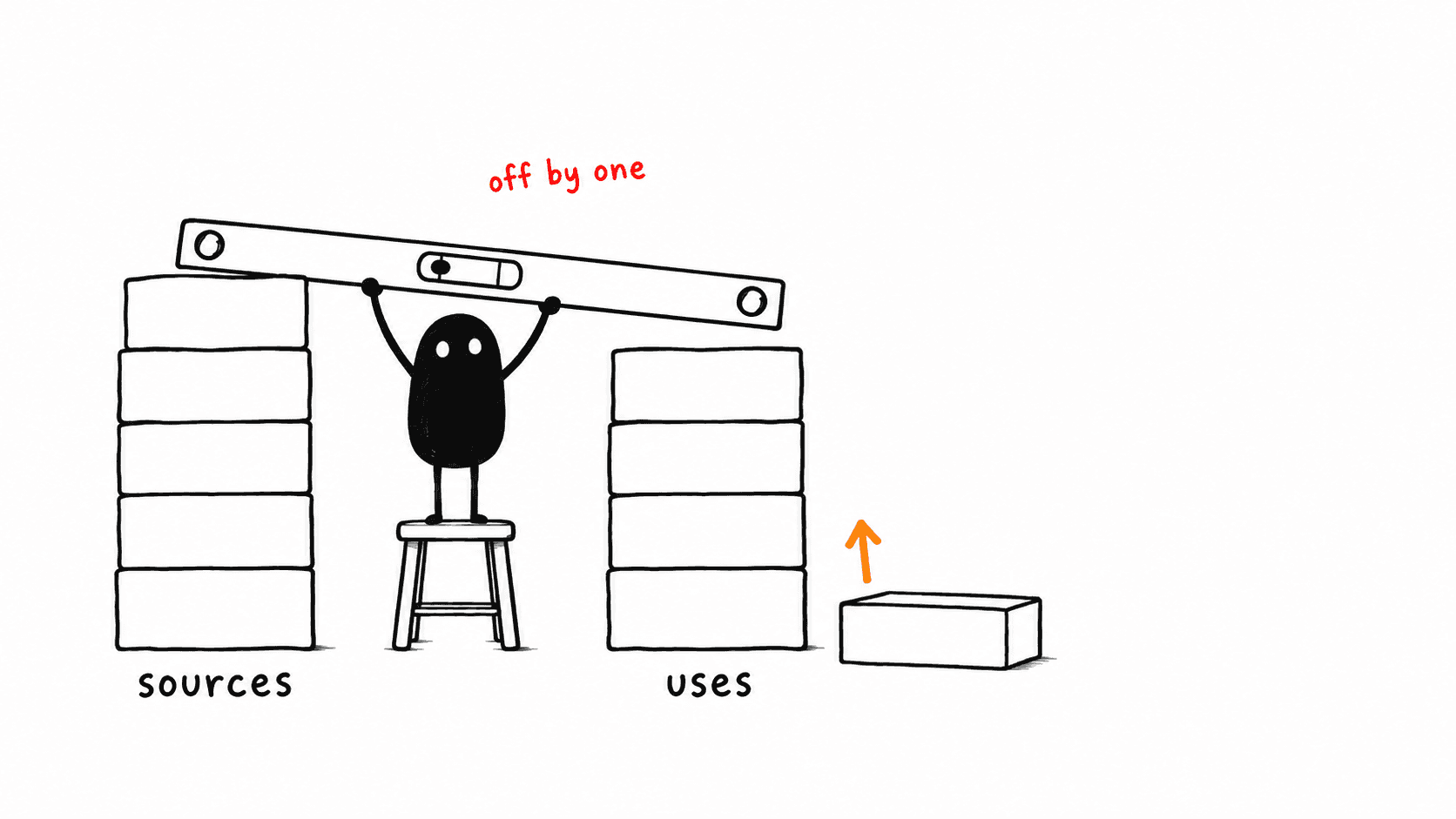
Build the check here: sources less uses must equal zero, with conditional formatting that makes a mismatch impossible to miss.
Step 2 — The opening balance sheet
Purchase accounting adjustments: write off the existing goodwill, calculate new goodwill as purchase price less the fair value of net identifiable assets, write up identifiable intangibles where the case specifies it, recognise the deferred tax liability that the write-up creates, capitalise financing fees as an asset to be amortised, and expense advisory fees against equity.
In a timed test, the examiner usually simplifies this — often to "assume no asset write-ups". Read the instructions before building it. Time spent on purchase accounting the case has told you to skip is time not spent on the returns calculation.
Step 3 — The operating build, kept proportionate
Project revenue, EBITDA and the cash flow items needed for debt service: D&A, capex, and the change in working capital. Nothing more elaborate than the case supports.
This is where most candidates over-invest. The returns are driven by three things — EBITDA growth, deleveraging and the exit multiple, and a highly granular revenue build changes only the first, usually marginally. A simple growth-rate build that lets you finish the model beats a segment-level build that leaves the debt schedule empty.
Stop at EBITDA and free cash flow before debt service. Interest needs the debt schedule.
Step 4 — The debt schedule and cash sweep
This is the engine of the model. For each tranche in seniority order: opening balance, mandatory amortisation, optional prepayment from the cash sweep, closing balance, and interest calculated on the balance.
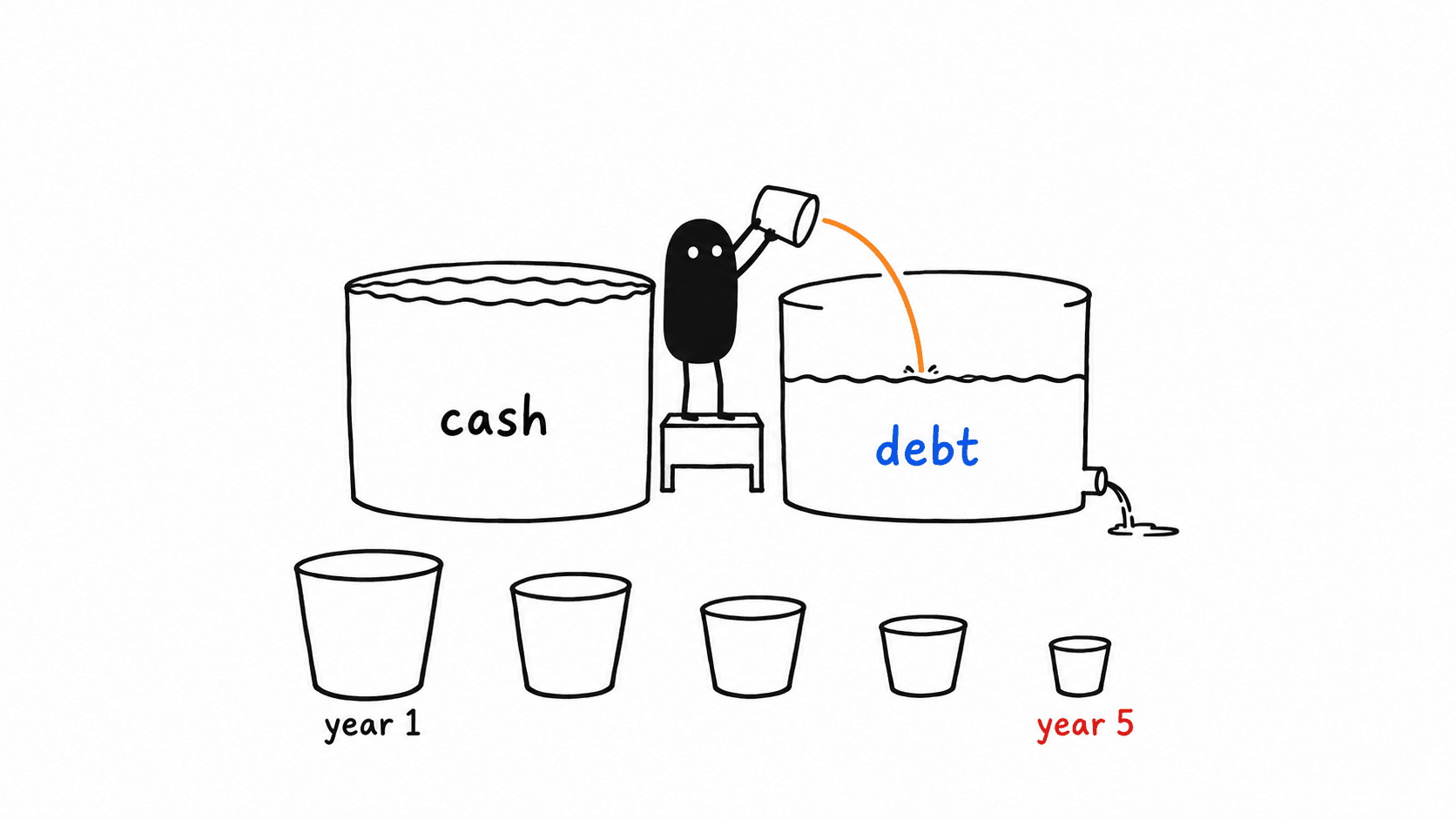
The waterfall of cash: start from cash available for debt service, pay cash interest, pay mandatory amortisation, then sweep whatever remains against the most senior prepayable tranche, respecting the minimum cash balance the business needs to operate. If cash would go below the minimum, the revolver draws.
Deleveraging is where a meaningful share of the equity return comes from, so this schedule is not a supporting detail — it is a primary driver of the answer. It is also where the circularity between interest and cash flow lives, so decide up front whether you are enabling iterative calculation or using opening balances for interest.
- Tranches in strict seniority: revolver, term loan A, term loan B, then subordinated or mezzanine.
- Mandatory amortisation before any sweep — it is contractual.
- A minimum cash balance the sweep is not allowed to breach.
- Cash interest and PIK interest handled separately; PIK accretes to the balance rather than consuming cash.
Step 5 — Exit and returns
Exit enterprise value is exit-year EBITDA times the exit multiple. Subtract net debt at exit to get exit equity value. MoIC is exit equity divided by the sponsor’s entry equity; IRR is the annualised equivalent over the hold period.
Continuing the earlier case: EBITDA grows from $50m to roughly $73m over five years and cumulative free cash flow of about $110m takes debt from $240m to $130m. Exiting at the same 8.0x gives $588m of enterprise value, less $130m of debt, for $458m of equity. Against $175m invested that is 2.6x, roughly a 21% IRR.
Hold the exit multiple flat unless the case gives you a reason not to. Assuming multiple expansion to make the returns work is the single fastest way to lose credibility with a private equity reviewer, because it is the one return driver the sponsor does not control.
Step 6 — The value creation bridge
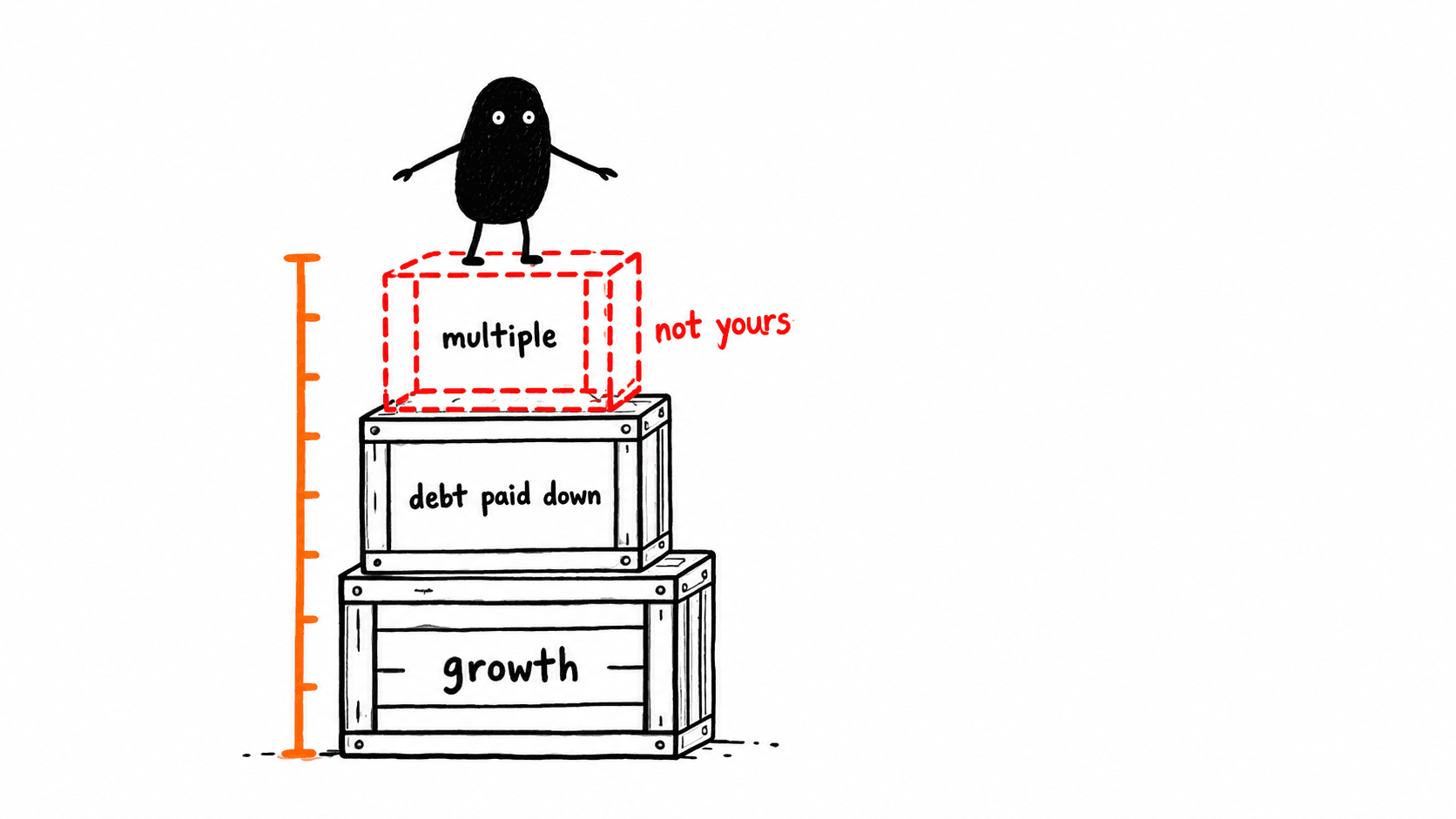
This is the output that separates a model from an answer, and the one most candidates omit. Decompose the equity return into its three sources: how much came from EBITDA growth, how much from debt paydown, and how much from multiple change.
The bridge is what an investment committee actually discusses. A deal whose return comes 70% from deleveraging is a fundamentally different proposition from one that depends on growing EBITDA by half, and the two carry different risks. Presenting the decomposition shows you understand what the model is telling you rather than merely that you can operate it.
It is also the fastest sanity check on your own work. If the bridge does not reconcile to the total equity gain, something upstream is wrong.
Sensitivities, and what to do when time runs out
Finish with a sensitivity table on IRR across entry multiple and exit multiple, and a second across leverage and EBITDA growth if time allows. Those four variables cover most of what a reviewer will ask.
If the clock is running out, the priority order is unambiguous: a working returns calculation with rough operating assumptions beats a sophisticated operating model with no returns. Get to an IRR, then improve. And state a recommendation — most tests ask what you would do, and a model that reaches no conclusion scores poorly regardless of how clean the mechanics are.
Frequently asked questions
What order should you build an LBO model in?
Transaction assumptions and sources and uses first, then the opening balance sheet adjustments, then a proportionate operating build to EBITDA and free cash flow, then the debt schedule with the cash sweep, then exit and returns, and finally the value creation bridge and sensitivities. Under time pressure, reaching a returns number with rough operating assumptions always beats a detailed operating model with no returns calculation.
What is a value creation bridge in an LBO model?
A decomposition of the equity return into its three sources: EBITDA growth, debt paydown, and multiple expansion or contraction. It is what an investment committee actually discusses, because a return driven mostly by deleveraging carries very different risk from one that depends on growing EBITDA substantially. It also serves as a reconciliation check on the model.
Should you assume multiple expansion in an LBO model?
Generally no. Hold the exit multiple flat at the entry multiple unless the case gives a specific reason otherwise, and consider haircutting it in a downside case. Multiple expansion is the one return driver a sponsor does not control, so relying on it to make returns work is the fastest way to lose credibility in a private equity review.
How does the cash sweep work in an LBO model?
After paying cash interest and mandatory amortisation, remaining free cash flow is applied to prepay debt, starting with the most senior prepayable tranche, subject to a minimum cash balance the business needs to operate. If cash would fall below that minimum, the revolver draws instead. The sweep is what drives deleveraging, which is a primary source of the equity return.
Now try it
LBO Modelling Test
The one-hour test, with marking. Sources and uses, a five-year operating model, a debt schedule with a cash sweep, exit and returns. Build it in the browser block by block, or download the workbook, build it in your own spreadsheet and upload it to be marked line by line.
Download the model
Leveraged buyout model
Sources and uses, a cash sweep, sponsor returns. Free Excel, formulas live, with a starter workbook.
Download the model
Credit model
Debt capacity, covenants, sweep, maturities, recovery. Free Excel, formulas live, with a starter workbook.
Related guides
Private Equity
Paper LBO Example: A Full Walkthrough, Step by Step
9 min read
Private Equity
The Private Equity Modelling Test: What to Expect and How to Prepare
9 min read
Financial Modelling
How to Build a Three-Statement Model That Actually Balances
13 min read
Financial Modelling
Financial Modelling Best Practices: The Conventions That Make a Model Auditable
11 min read
Interview Prep
Stocks and Bonds, and Why the Difference Decides Everything
9 min read
Want this applied to your recruiting?
Reading is the easy part. For practitioner feedback tailored to your situation, work 1:1 with Suro.