Restructuring groups interview with the standard IB technical bank plus a distressed layer — waterfalls, the fulcrum, Chapter 11 mechanics, and valuation when the going concern is in question. RX also expects sharper answers, because the group's work is precisely about being right when capital structures break.
"Walk me through a recovery waterfall"
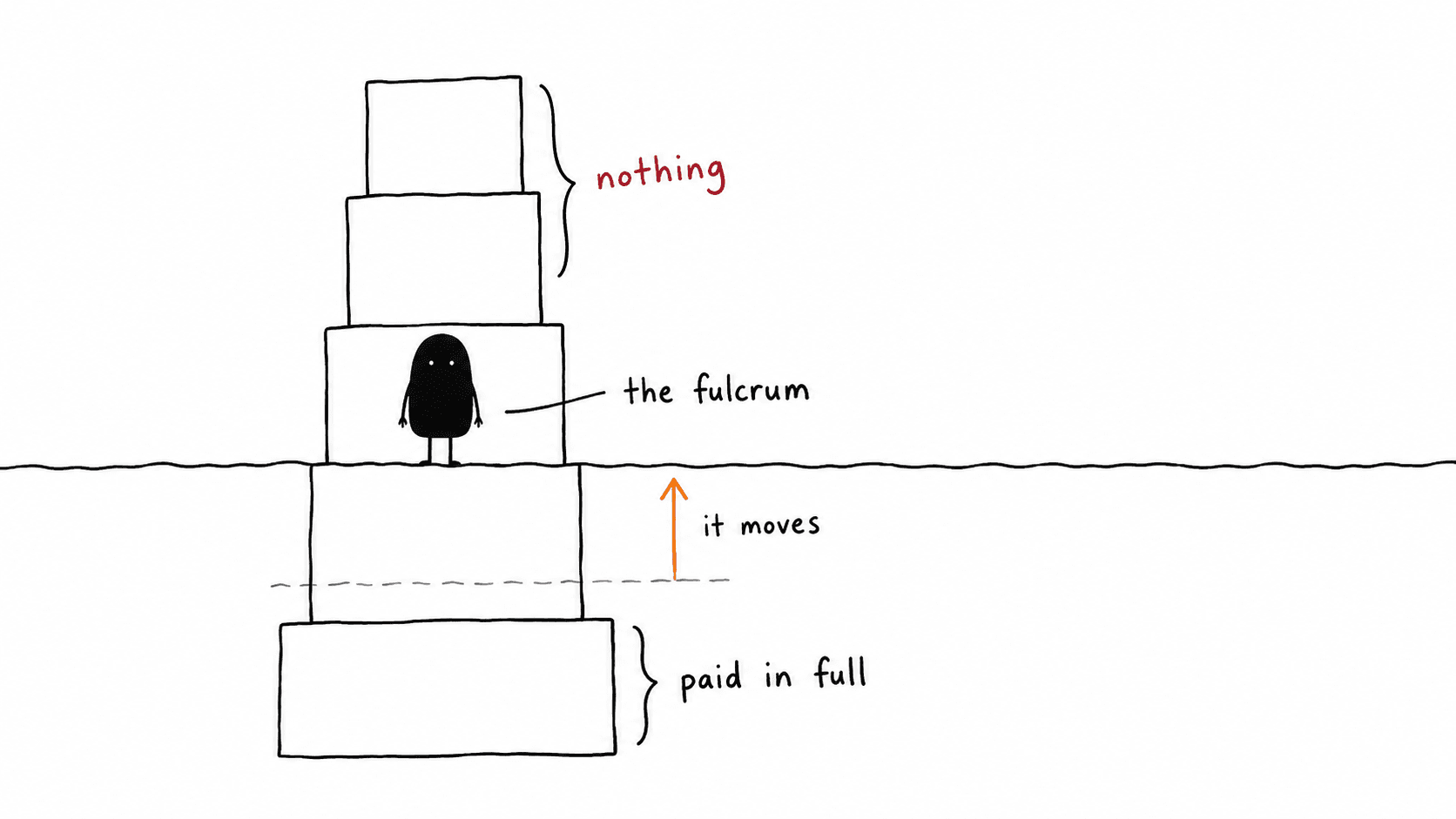
Value is distributed by absolute priority: secured creditors first (up to the value of their collateral), then unsecured creditors, then subordinated debt, then preferred, then common equity — each class paid in full before the next receives anything. The exercise in practice: estimate enterprise value, then pour it down the stack until it runs out.
Example to narrate: EV of $600m against $400m secured and $300m unsecured. Secured recovers 100%. Unsecured receives the remaining $200m — about 67 cents on the dollar. Equity gets nothing. The unsecured class is where value "breaks".
"What is the fulcrum security?"
The class where value runs out — partially recovered, and therefore the class that typically converts into ownership of the reorganised company. In the example above, the unsecured notes are the fulcrum. Identifying it matters because distressed investors buy the fulcrum to own the post-restructuring equity, and because the fulcrum class has the strongest incentive to fight over the valuation: a higher EV pushes value down the stack to them, a lower one concentrates it above.
The natural follow-up — "who argues for a HIGH valuation in a restructuring, and who argues LOW?" — junior classes and equity argue high (value reaches them); senior classes argue low (they take the company cheaply). Valuation in restructuring is adversarial, not academic.
Chapter 11 mechanics worth knowing cold
- Automatic stay: filing freezes creditor collection actions, giving the debtor room to reorganise.
- DIP financing: new money with super-priority status that funds operations during the case.
- Plan of reorganisation: voted by impaired classes, confirmed by the court; cramdown allows confirmation over a dissenting class if the plan is fair and equitable.
- 363 sale: selling assets through the court process, free and clear of claims — the alternative to a standalone reorganisation.
- Pre-pack: a plan negotiated and voted before filing, taking the company through court in weeks rather than years.
Distressed valuation questions
- "How do you value a distressed company?" — same toolkit (comps, DCF), plus liquidation analysis as the floor; the reorganisation-vs-liquidation comparison is required in a plan (best-interests test). Normalise EBITDA carefully: distressed financials are full of one-offs.
- "Why might a bond trade at 60 with the company still paying coupons?" — the market is pricing restructuring probability and expected recovery, not just current payment status. Yield-to-worst vs price tells you what default scenario is embedded.
- "What is a distressed exchange?" — an out-of-court swap of existing debt for new securities at a discount; rating agencies typically treat it as a default even though no filing occurs.
Why RX interviews feel harder
The content is only one layer deeper, but RX groups deliberately probe reasoning under adversarial framing — every valuation number in a restructuring has a party who benefits from moving it. Showing you understand WHO wants WHAT in the capital structure, not just the mechanics, is what separates candidates here.
Frequently asked questions
What is the fulcrum security in a restructuring?
The class in the capital structure where enterprise value runs out — partially recovered, and typically the class that converts into equity ownership of the reorganised company. Distressed investors target it to own the post-restructuring business.
What is absolute priority in a recovery waterfall?
The rule that each class must be paid in full before the class below it receives anything: secured, then unsecured, then subordinated, then preferred, then common equity.
Which banks are strongest in restructuring?
The advisory-led RX practices — Houlihan Lokey, PJT Partners, Evercore, Lazard, Moelis among the best known, because conflict rules often keep balance-sheet banks out of debtor mandates against their own lending arms.
Now try it
Optimal Capital Structure
Why not just borrow more? Step leverage up and watch coverage fall, the rating decay and the spread widen until WACC bottoms out.
Download the model
13-week cash flow model
Weekly receipts, disbursements, revolver, liquidity. Free Excel, formulas live, with a starter workbook.
Download the model
Credit model
Debt capacity, covenants, sweep, maturities, recovery. Free Excel, formulas live, with a starter workbook.
Download the model
Recovery waterfall model
Claims by class, priority, recovery, the fulcrum. Free Excel, formulas live, with a starter workbook.
Related guides
Want this applied to your recruiting?
Reading is the easy part. For practitioner feedback tailored to your situation, work 1:1 with Suro.