Enterprise value vs. equity value is probably the single most frequently tested concept in entry-level finance interviews, because everything else in valuation sits on top of it. Candidates who can recite the definitions still get caught by the follow-ups — the bridge, the pairing rules, and the "what happens to EV if…" scenarios.
The definitions that actually stick
Equity value is what the shareholders' claim is worth: share price × diluted shares outstanding. Enterprise value is what the whole operating business is worth to ALL capital providers: equity holders, debt holders, preferred holders, minority interests. The house analogy holds: the house price is enterprise value; your deposit (equity) plus the mortgage (debt) funds it, and your equity is the house value minus what is still owed.
The bridge
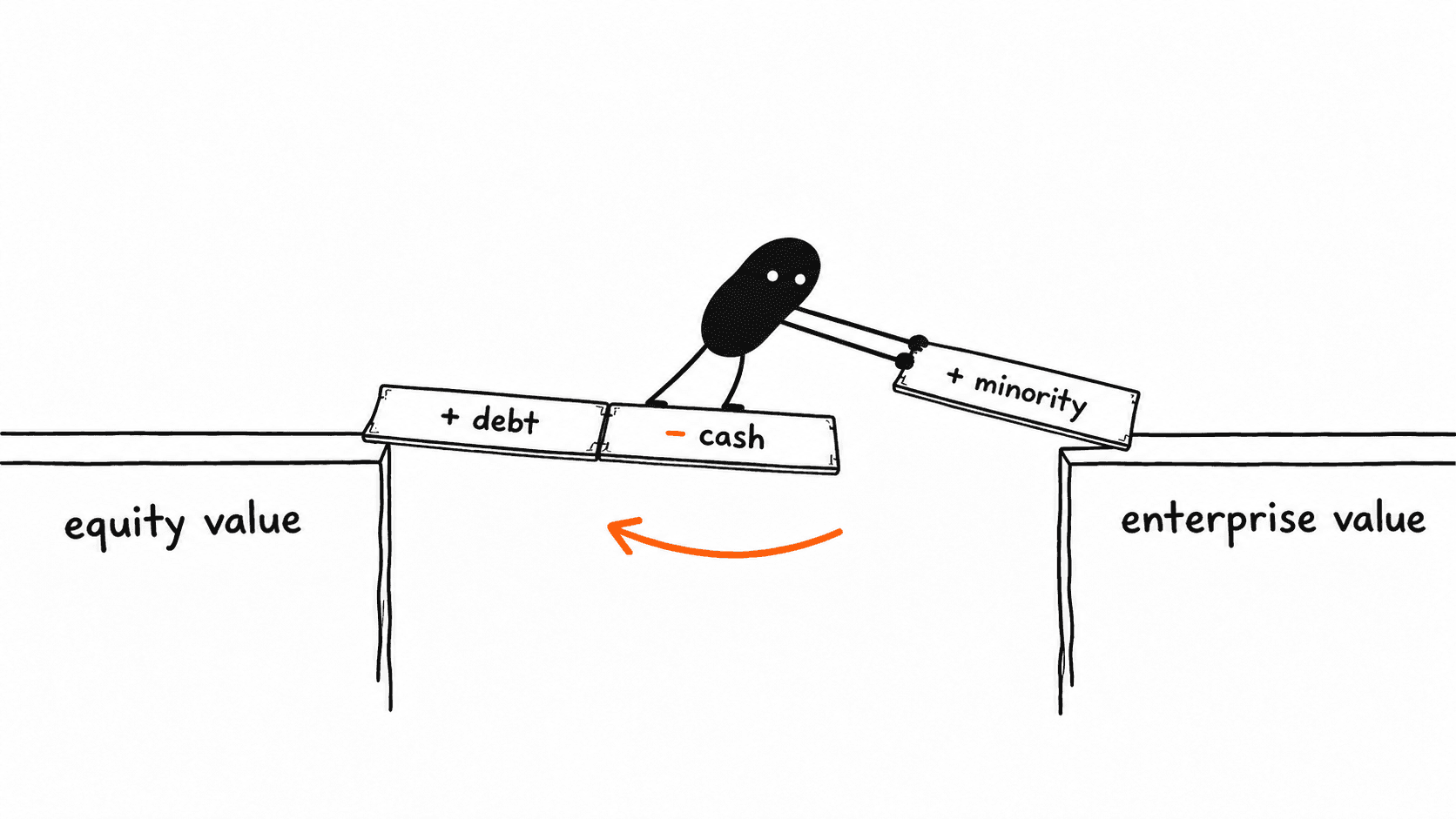
Enterprise value = equity value + total debt + preferred stock + minority interest − cash and equivalents. Cash is subtracted because a buyer effectively receives it back at closing (or equivalently, it could repay debt immediately), which is also why "net debt" (debt minus cash) is the compact form of the bridge.
Which multiples pair with which, and why
The rule: the numerator and denominator must serve the same claimholders. EV pairs with metrics available to all capital providers (revenue, EBITDA, EBIT — all before interest). Equity value pairs with metrics after debt holders have been paid (net income, book equity, free cash flow to equity).
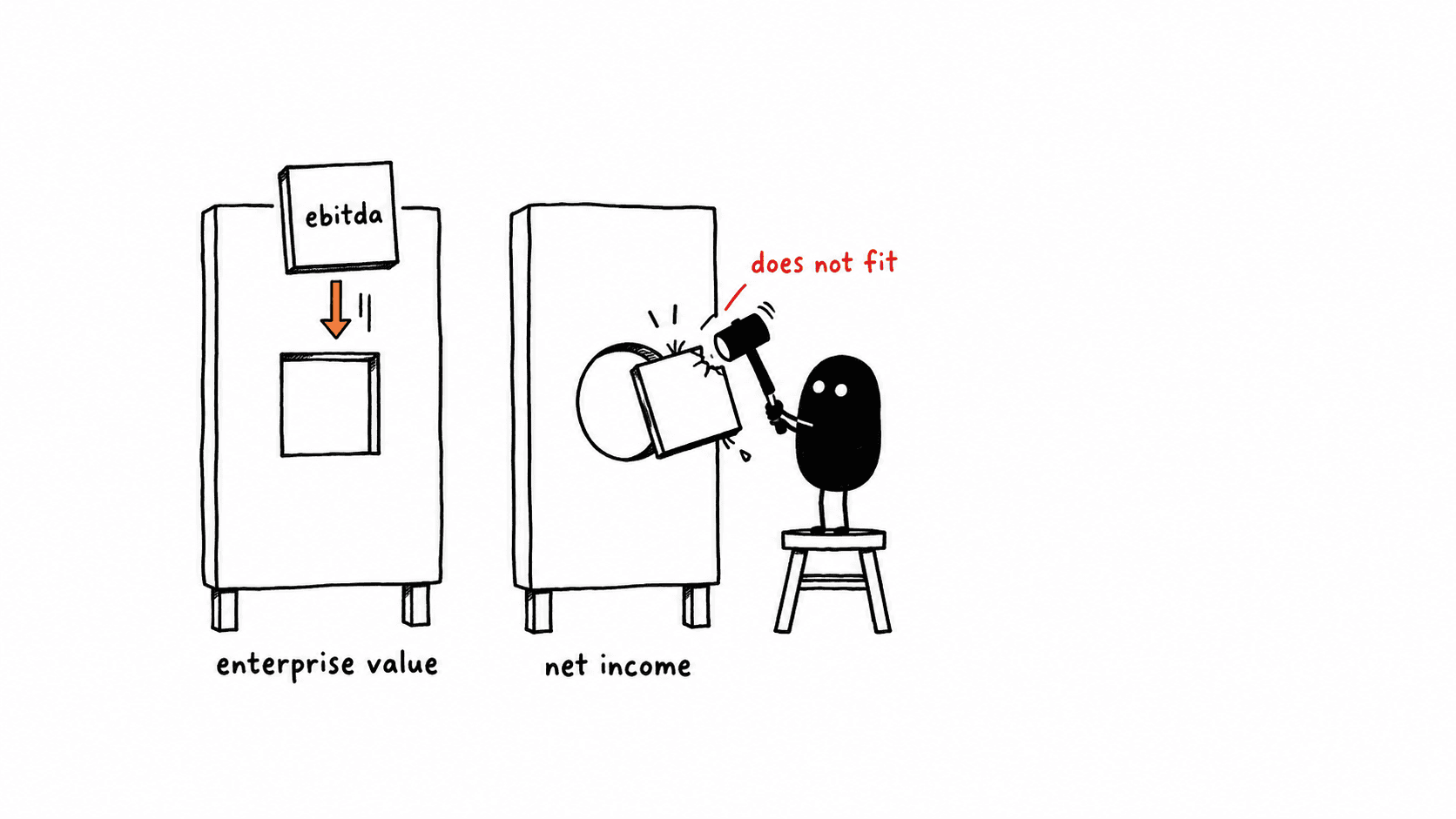
- EV/EBITDA, EV/EBIT, EV/Revenue — correct: pre-interest metrics against the all-capital value.
- P/E (equity value / net income) — correct: post-interest earnings against the equity claim.
- EV/Net income — wrong: mixes an all-capital numerator with an equity-only denominator. Being able to say WHY it is wrong is the actual test.
The "what happens to EV if…" follow-ups
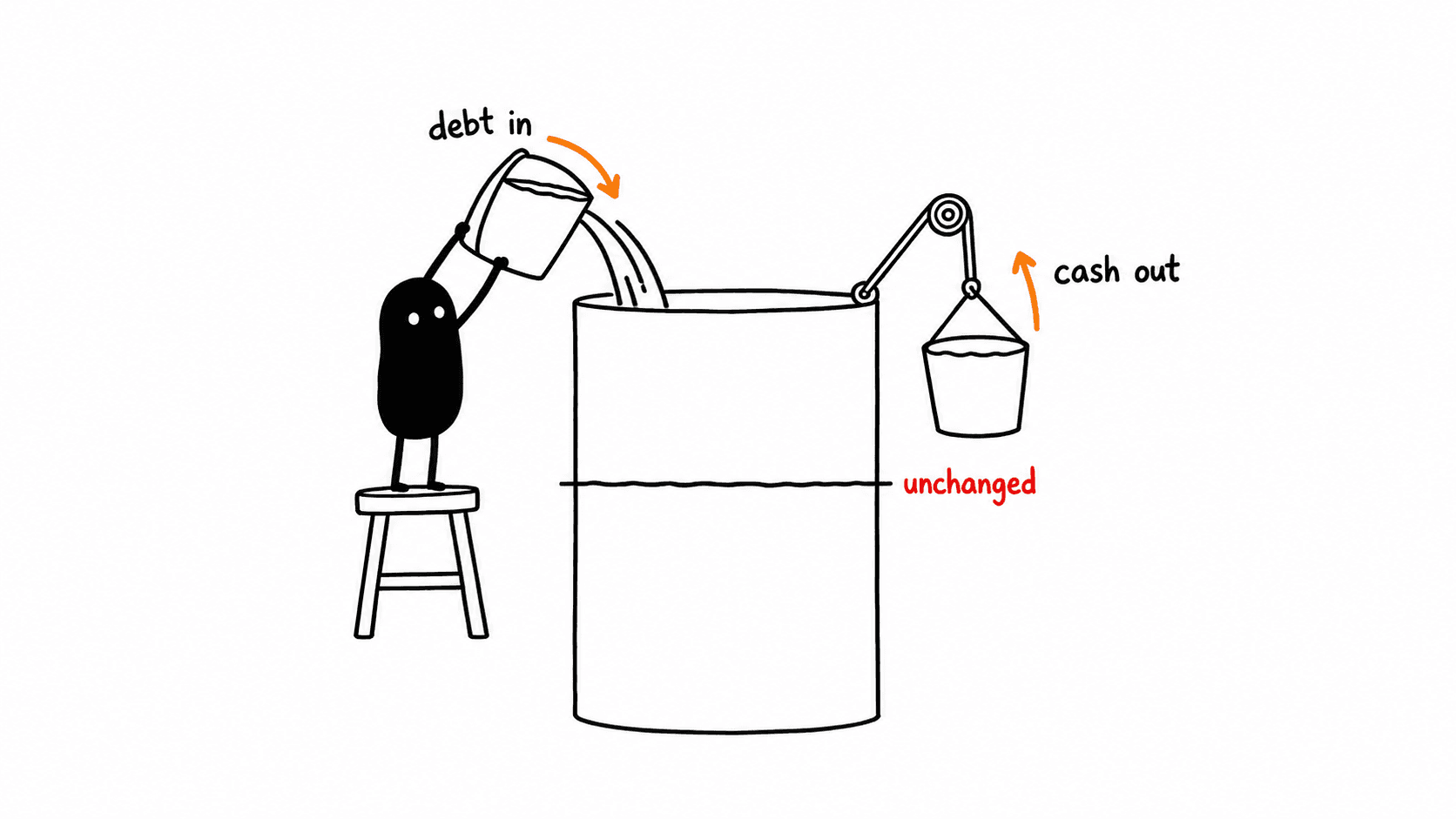
- "The company raises $500m of debt and holds it as cash" — EV unchanged: debt up, cash up, they cancel in the bridge. Equity value also unchanged. (The classic.)
- "The company uses $500m of cash to pay a dividend" — equity value falls by the dividend; EV unchanged (cash down offsets equity down in the bridge — the operating business is worth the same).
- "The company issues $500m of stock and keeps the proceeds as cash" — equity value up $500m, EV unchanged (cash up cancels it). EV only moves when the value of the operating business moves.
- "Can enterprise value be negative?" — yes, when cash exceeds the sum of equity value and debt (seen occasionally in distressed or deeply out-of-favour cash-rich companies); it usually signals the market expects the cash to be destroyed rather than returned.
Why diluted shares, and what dilutes
Equity value uses diluted shares: in-the-money options and warrants (via the treasury stock method) and convertible securities where conversion is economic. Interviewers commonly follow up with "walk me through the treasury stock method" — buy-in proceeds from option exercise are assumed to repurchase shares at the current price, so only the net new shares add to the count.
Frequently asked questions
Why is cash subtracted in the enterprise value bridge?
Because a buyer of the whole business effectively gets the cash back — it can be used to repay acquisition debt or distributed immediately. EV is meant to price the operating business alone, so non-operating cash comes out.
Why does EV/EBITDA work but EV/Net income not?
Numerator and denominator must serve the same claimholders. EBITDA is before interest, so it belongs to all capital providers — matching EV. Net income is after interest, an equity-only metric, so it pairs with equity value (P/E), not EV.
Does raising debt change enterprise value?
Not by itself. If the proceeds are held as cash, debt up and cash up cancel in the bridge. EV changes when the market's view of the operating business changes, not when the financing mix changes.
Now try it
EV to Equity Bridge
Where two analysts who agree on EBITDA still end up far apart. Net debt, pensions, NCI, leases and the treasury stock method, each opening to its own inputs.
Download the model
Discounted cash flow model
Unlevered free cash flow to a share price. Free Excel, formulas live, with a starter workbook.
Download the model
Merger model: accretion and dilution
Is the deal accretive, and what would break even. Free Excel, formulas live, with a starter workbook.
Download the model
Comparable companies model
Calendarised, LTM, trading and transaction multiples. Free Excel, formulas live, with a starter workbook.
Related guides
Investment Banking
Comparable Companies (Comps) Interview Questions
7 min read
Investment Banking
"Walk Me Through the Three Statements" — And Every Follow-Up
7 min read
Investment Banking
DCF Interview Questions: The Ones That Actually Come Up
8 min read
Interview Prep
Stocks and Bonds, and Why the Difference Decides Everything
9 min read
Want this applied to your recruiting?
Reading is the easy part. For practitioner feedback tailored to your situation, work 1:1 with Suro.