Barclays — Discovery Programme
Spring Week · Investment Banking · Applicants choose a division
Commonly called Barclays Spring Week, or the Spring Insight Programme.
Status
Opening SoonLocation
London
Level
Internship
Deadline
Not published
Status checked against the firm's careers feed — last synced 14 October 2026.
Key details
- Expected opening
- October 2026, on the pattern of previous cycles. Estimated
- Confirmed opening date
- Not yet published. The Discovery page currently takes a registration of interest and says it will notify registrants when applications open. Official
- Deadline
- Not published. Previous cycles have run roughly five to six weeks from application to decision. Estimated
- Last checked
- 3 September 2026, against Barclays' own Discovery and application pages. Official
Applications are commonly reviewed as they arrive and windows close early when a cohort fills, so the deadline is the last useful date rather than the intended one.
- Cover letter: Not required
- Visa sponsorship: Two separate positions, and they differ. Barclays did not sponsor attendance at the two-day 2026 Finance Discovery Programme and expected right to work in the country of the programme. For the internship that followed, it indicated that qualifying candidates could be considered for Skilled Worker sponsorship. Read both on your own listing, because the programme and the internship are decided separately.
Are you eligible?
Check your year group
Barclays asks for students two years away from graduation. Measured from the programme rather than from the application, that is your first year on a three-year degree and your second on a four-year one.
A year group is a convention, not a rule. The wording on the employer's own listing decides it.
What the Discovery Programme involves
Barclays Discovery is a short insight programme for students who are still around two years from graduating. It runs in two parts: sessions and workshops that explain how the bank works, then a second part about the practical next steps into an internship, which varies by location.
The programme is short, so its value is not the two days themselves. It is the access to people in the division you are aiming at, and the position it puts you in for the following year.
Where it leads Official
Discovery Programme → summer internship consideration in the following cycle → graduate offer after a successful internship
Barclays states that Discovery participants may be considered for one of its internships. That is the reason a two-day programme is worth an application: the internship is the route to a graduate offer, and this is the earliest point at which the bank can meet you. The internship it feeds is the one that follows your programme, so read the year named on your own listing rather than assuming the year in the programme's title.
Who this is for
- Year of study
- Students two years away from graduation. On a three-year UK degree that is your first year; on a four-year degree, your second. Official
- Degree discipline
- Any discipline for the 2026 Finance cycle. Barclays sets this per programme, so confirm it on the listing for the division you want. Official
- Division
- You apply to a division rather than to the bank. Barclays lists Discovery programmes across areas from technology and operations to finance and investment banking. Official
- Format
- Recent Discovery programmes have run virtually over two days. Barclays says the second part of the programme varies by location. Estimated
- Regions
- Programmes run across the UK, the Americas and Asia Pacific. Official
- Sponsorship, this programme
- Barclays did not sponsor attendance at the two-day 2026 Finance Discovery Programme. Right to work in the country of the programme was expected. Official
- Sponsorship, the internship after it
- Treated separately, and more generously. On the 2026 Finance cycle Barclays indicated that qualifying candidates progressing to the internship that followed could be considered for Skilled Worker sponsorship. That is the precedent rather than a promise for your cycle, so confirm the wording on your own listing. Official
Barclays' Discovery page currently takes a registration of interest rather than an application, and has not published an opening date for the next cycle.
What happens after you apply
Three accounts of the process circulate and they do not fully agree. Where they conflict, the stages named in your own invitation email are the ones that apply to you.
Barclays' current early careers guidance Official
- Application form
- →Two interactive assessments
- →Assessment centre
The assessments cover workplace performance and work style preferences, with an extra technical assessment for technology programmes. The assessment centre runs in person or virtually across two or three stages, including a motivational interview with a member of the leadership team.
Accounts from previous Discovery cycles Candidate-reported
- Application
- →Online assessments
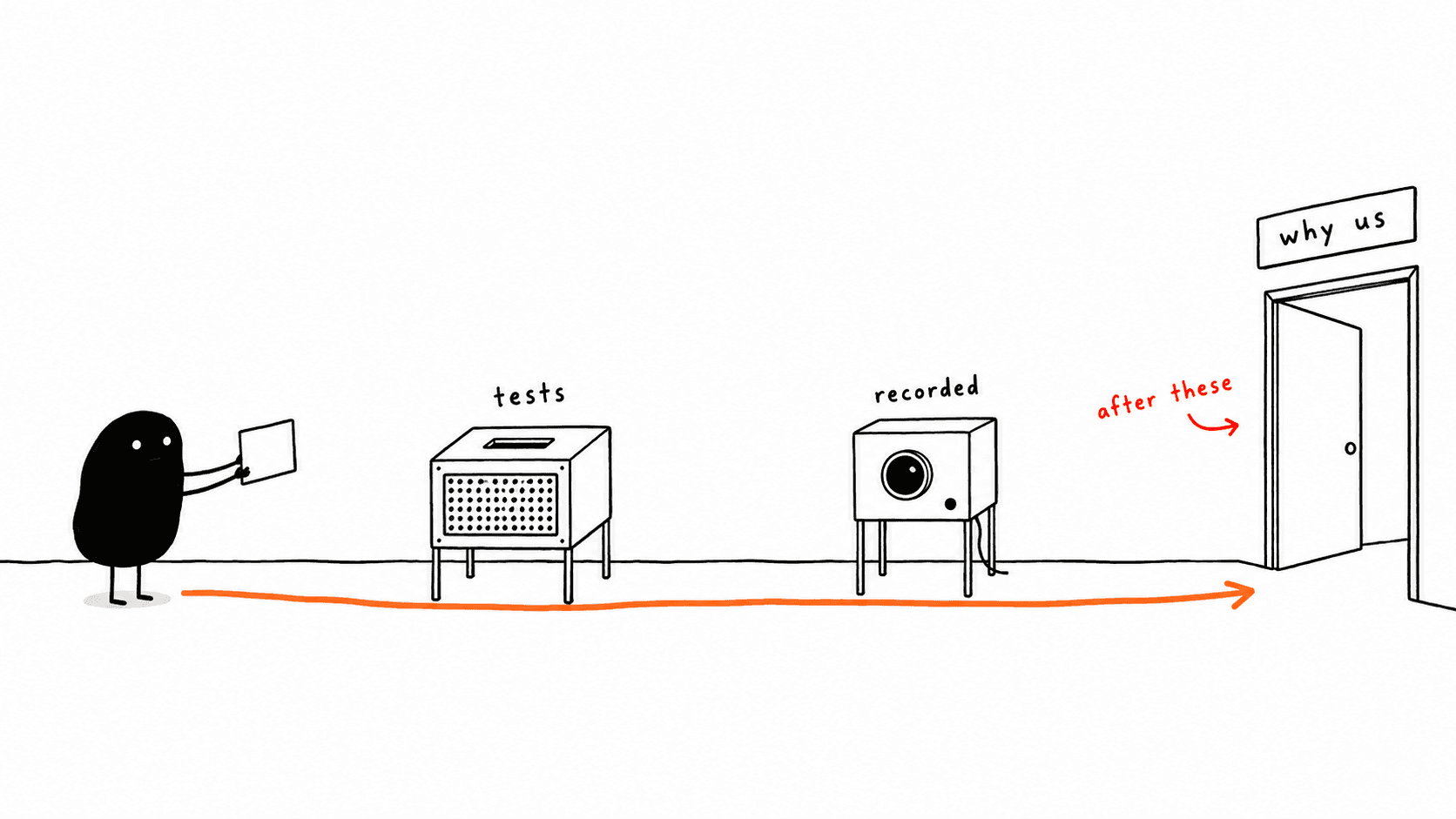
- →Recorded video interview
Candidates have described a recorded interview of six competency questions with two minutes for each and no follow-ups. The full process from submission to decision has run roughly five to six weeks.
Your own invitation Official
- Follow the stages and the provider named in your email
Barclays hosts most assessments on its own digital platform and the stack changes between cycles. The email is the authority for your cycle, your division and your region.
What they assess
Barclays frames its culture around the values Respect, Integrity, Service, Excellence and Stewardship, and the mindset Empower, Challenge and Drive. Those words appear in the assessment criteria, so it is worth knowing what each looks like in an answer rather than reciting the list back.
Empower
Supporting other people and making them more effective, not doing their work for them.
Challenge
Questioning an approach constructively, and being specific about what you would do instead.
Drive
Taking ownership of an outcome and delivering it, including the unglamorous part.
Respect and integrity
Handling disagreement or pressure properly, especially when you were the one under it.
Service
Understanding the person or the client on the end of the work.
Stewardship
Leaving a process or a group better than you found it, after you had stopped benefiting from it.
What a strong application looks like
For "why Barclays?", a strong answer has three parts: one specific reason tied to Barclays’ position or business model, one tied to the division you selected, and one experience of your own that shows why that work suits you. The middle part is the one most answers leave out, and it is the one that shows you applied to a team rather than to a logo.
WeakBarclays is a leading global bank with a strong reputation and great people.
StrongerBarclays runs a UK high street bank and a full corporate and investment bank inside one group, which is unusual, and the Finance function has to report across both.
WeakI want to work in investment banking because I enjoy fast-paced environments.
StrongerI applied to Risk because the interesting question there is how much of a loss the bank can absorb before it changes behaviour, and I want to learn how that number gets set.
Practise these
Eight questions specific to Barclays and to the division you pick. Answer them for the division on your application, not for the bank in general.
Motivation
Why Barclays rather than another universal bank?
Division
Why this division, and what do you believe it actually does day to day?
Motivation
How would you make the most of two days on the Discovery Programme?
Challenge
Tell me about a time you challenged an established approach.
Drive
Tell me about a time you took ownership when something went wrong.
Commercial awareness
Describe a recent transaction or market development that interested you, and why.
Curiosity
What would you want to learn from the analysts and graduates you meet?
Recorded interview
Any of the above, in two minutes, to a camera, with no follow-up question to rescue you.
Practise the recorded round →
A seven-day plan
The recorded round rewards preparation more than any other stage, because two minutes is the whole brief and there is no recovery from a rambling answer.
- Day 1Pick the division, and read what it does rather than what the bank says about itself.
- Day 2Write the three-part "why Barclays" answer, then cut it to 100 seconds.
- Day 3Build six competency stories in STAR form: teamwork, failure, leadership, conflict, initiative, and interest in the division.
- Day 4Two recent developments in your division, with a view on each. Not a summary, a view.
- Day 5Record all six answers, watch them back, and cut every one to 100 seconds.
- Day 6Practise the interactive assessments untimed once, then timed.
- Day 7Prepare the questions you will ask, and re-read the invitation email for the actual stages.
Similar programmes
J.P. Morgan · Spring into J.P. Morgan
Same year group. A game-based assessment sits early enough to end an application before a human reads it.
Citi · Spring Insight, 1st Year Programme
Also division-specific, so a generic "why Citi" answer fails early there too.
Search the tracker for whichever of these is open now.
How to prepare for this one
Insight programmes screen on motivation and awareness more than technical depth, but the online tests and the recorded interview still filter hard.
- Investment Banking preparation guide
- Spring Week vs Summer Internship vs Industrial Placement
- UK Spring Weeks: Timeline, Assessments, and How Offers Are Decided
- The Finance CV: One Page That Survives a 30-Second Skim
- All interview guides
Practise it, don't just read it
Free, no sign-up, and short enough to finish before you submit.
Build the model this seat is tested on
A working Excel model with live formulas. Work with it online free: change the inputs and watch it recalculate. A free account also takes the starter workbook to build yourself.
Browse all 19 modelsWalk in with something
Each of these produces a piece of work an interviewer at Barclays can ask you about. Free to run as a preview; Pro runs the full version on the stronger engine.
Sources and changes
Checked against
- Barclays — Discovery Programme
- Barclays — early careers application process
- Barclays — our story, values and mindset
Anything on this page badged candidate-reported is reconstructed from multiple accounts of recent cycles rather than from the employer, and the specifics move by cycle and by location. Last verified 3 September 2026.
What changed
- 3 September 2026 Renamed to the Discovery Programme, which is what Barclays calls it now, keeping the spring week wording applicants search for. The process is now given as three separate accounts: the bank's current guidance, previous candidate accounts, and the stages named in your own invitation. The 1 October opening date is stated as an expectation rather than a date, because the Discovery page currently takes a registration of interest and publishes none.
Also open in Investment Banking
- Rothschild & Co · Spring Insight Week, Global AdvisoryLondon · Open
- J.P. Morgan · Spring into J.P. MorganLondon · Opening Soon
- Goldman Sachs · Spring Insight ProgrammeLondon · Opening Soon
- Morgan Stanley · Spring Insight ProgrammeLondon · Opening Soon
- Citi · Spring Insight, 1st Year ProgrammeLondon · Opening Soon
- Bank of America · Industrial Placement, IBDLondon · Open
Every open role on the tracker across all verticals and regions.
More tracked roles at Barclays
- US Early Careers Discovery ProgrammesNew York, NY · Opening Soon
- Global Transaction Banking Graduate Programme 2027 ParisParis, 52 avenue Hoche · Listed
- Private Bank and Wealth Management Off Cycle Internship Programme 2027 GenevaGeneva, 18-20 Chemin de Grange-Canal · Listed
- 2027 Human Resources Industrial Placement Programme LondonCanary Wharf, 1 Churchill Place · Closing Soon
- 2027 Risk Analyst Higher Apprenticeship Programme NorthamptonNorthampton, Barclays Campus, Pavilion Drive · Listed
- 2027 Operations Analyst Summer Internship Programme KnutsfordKnutsford, Radbroke Hall · Closing Soon
Full Barclays intelligence page — every tracked programme, plus interview reports.
Get told when roles like this open
The day applications open matters more than the deadline printed next to it, and the opening date is the one employers publish late or not at all. Leave your email and we will tell you when the roles you care about go live.
One email when a role opens, plus a short weekly round-up in season. Free, and you can leave at any point.
Before you send it
Barclays screens on the document, not the intention. Suro reads your CV the way the screener will and writes back in the margin: structure, whether the bullets carry evidence, and whether it survives the parser. Back within 48 hours.
Send this to someone applying 📌
Instagram and TikTok have no desktop share link, so copy the caption and paste it into the app.
Seen something different on Barclays's own pages?
Dates move and stages change mid-cycle. If this page is wrong, the fastest way to fix it is to tell us what you saw.