Sell-Side / Buy-Side
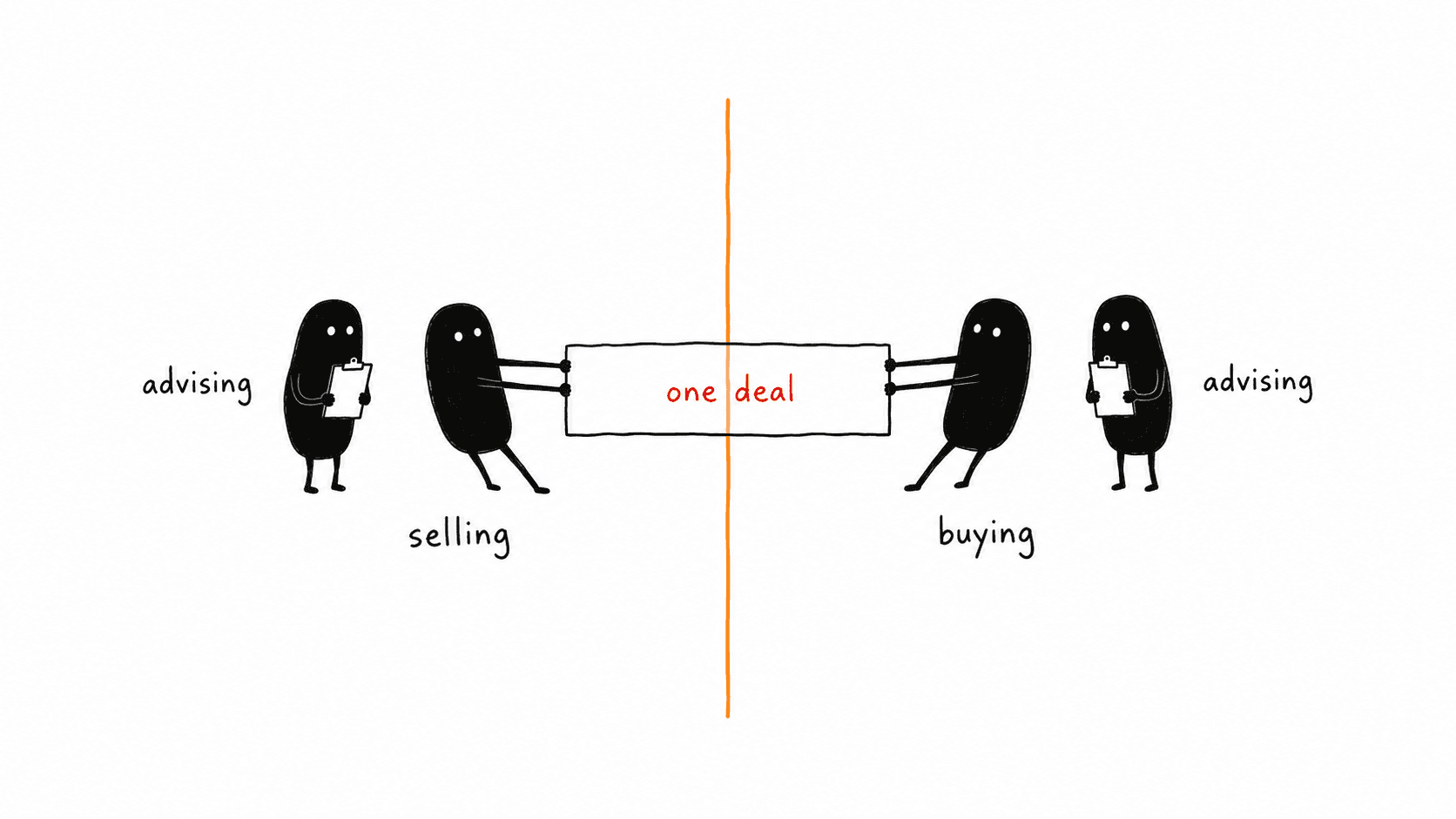
Sell-side refers to firms that advise companies raising capital or selling assets (banks); buy-side refers to firms that invest capital (PE funds, hedge funds, asset managers). A single M&A deal typically has a sell-side advisor and a buy-side advisor.
Who is on the buy side · 1 of 17Next: LP / GP
Sell-Side / Buy-Side · the mechanism
1 min read
Say what each side actually does all day, and answer "why the buy side" without insulting the sell side.
Where it comes up. An interviewer asks why you want to move across, and can tell within a sentence whether you are running toward something or away from the hours.
The sell side sells services and securities
Banks, brokers and research houses. They advise on transactions, raise capital, make markets and publish research. They are paid fees and commissions, which means their product is execution and distribution, and their client is the issuer or the investor rather than a pool of capital.
The buy side deploys capital
Asset managers, hedge funds, private equity, pensions, insurers and sovereign funds. They take positions with money they are responsible for, and they are paid on assets and performance. Their product is a return.
Understand what that changes about the work
The sell side optimises for volume, responsiveness and relationships: many clients, many transactions, deadlines set by other people. The buy side optimises for being right: fewer decisions, more consequence, and the ability to say no to almost everything. That is the real difference in the day, and it is what an interviewer is testing when they ask why you want to move.
Check yourselfHow would you answer "why the buy side" without saying the hours are better?
Answer once you have one →
Talk about ownership of a view. On the sell side you build the analysis and someone else takes the risk; on the buy side you carry the position and find out whether you were right. Name something specific you would want to own a view on, and be honest that the trade-off is fewer at-bats and more accountability for each. Answers that lead with lifestyle read as running away from something rather than toward it, and the hours on much of the buy side are not obviously better anyway.
Be able to say this back next week
- Defined each side by how it is paid rather than by prestige
- Named the difference in the day: volume and responsiveness against being right
- Answered “why the buy side” with ownership of a view, not with hours
Why Sell-Side / Buy-Side matters in interviews
Almost every finance career question resolves to which side of this line you sit on, and interviewers ask it to find out whether you understand the industry you are applying to or only the job. It also decides what your day looks like, who pays you and what you are actually measured on.
How it works in practice
The sell side creates, markets and transacts securities and advice: investment banks, brokerages, market makers, equity research at a bank. The buy side deploys capital and owns the resulting positions: private equity, hedge funds, asset managers, pension funds, sovereign wealth funds, family offices, venture capital. The names describe which end of a transaction the firm habitually stands at, not whether it is buying or selling on any given day.
In M&A the terms narrow to the mandate rather than the firm. A bank advising the seller is running a sell-side process: building the CIM, marketing to a buyer list, running the auction. The same bank on the same day can run a buy-side mandate for an acquirer, screening targets and advising on price. So "we ran a sell-side" describes a role in one deal, while "she moved to the buy side" describes a career.
Research is where the distinction bites hardest. A sell-side analyst publishes to clients and is measured on whether people read, trust and trade on the work. A buy-side analyst writes for an internal investment committee and is measured on whether the position made money. One is judged on influence, the other on profit and loss, and that difference explains almost everything about how the two jobs feel.
The flow is overwhelmingly one-directional. Buy-side seats are mostly filled from the sell side, which is why banking analyst programmes function as the industry’s training pipeline and why private equity on-cycle recruiting begins within months of an analyst starting. Very few people go the other way by choice.
What candidates get wrong
- Saying the buy side buys and the sell side sells. Both do both constantly. The distinction is whether the firm ultimately holds the risk or intermediates it for a fee.
- Assuming the buy side is uniformly better paid. At the top it is, and the ceiling is far higher because compensation ties to fund performance rather than to a bonus pool. Early on the two are much closer, and the buy side carries more seat risk.
- Forgetting that trading spans both. A bank’s market-making desk is sell side, providing liquidity for a spread. A hedge fund taking directional risk is buy side. Both people call themselves traders.
Sell-Side / Buy-Side: frequently asked questions
What is the difference between the buy side and the sell side?
The sell side originates, markets and transacts securities and advice for a fee: investment banks, brokers, market makers and sell-side equity research. The buy side commits capital and owns the resulting position: private equity firms, hedge funds, asset managers, pension funds and sovereign wealth funds. The clean test is who carries the risk afterwards. A sell-side firm is paid whether or not the trade works; a buy-side firm is paid by whether it works.
Is investment banking buy side or sell side?
Investment banking is sell side. A bank advises, underwrites and distributes, and earns a fee for doing so rather than holding the asset. The confusion comes from M&A, where a banker can be hired by an acquirer and run a buy-side mandate — but the bank is still a sell-side firm doing buy-side work on that particular deal.
Which pays more, buy side or sell side?
Over a career the buy side, and by a wide margin at the top, because compensation is linked to fund performance through carried interest or a share of trading profits rather than to a bonus pool. In the first two or three years the gap is much narrower than students expect. The buy side also carries materially more seat risk: a sustained period of poor performance ends a hedge fund role in a way that a quiet year rarely ends a banking one.
How do you move from the sell side to the buy side?
The standard route is a bank analyst programme followed by on-cycle private equity recruiting, which headhunters now run within months of an analyst starting. Hedge fund moves are more often off-cycle and turn on the strength of a stock pitch you bring rather than on a process you were invited into. Moving the other way, from buy side to sell side, is uncommon and usually a deliberate choice rather than a step up.
Where Sell-Side / Buy-Side comes up
Keep reading
Investment Banking interview prepRelated Investment Banking terms
Who is on the buy side: keep going
Go further than reading
The written material is free. These are the ways to get it applied to your own work.
CV Review by a Human
Written margin-note feedback on structure, impact bullets and ATS-readability. Reviewed by Suro, not an AI score.
$25 48h turnaround
Cover Letter Review by a Human
Line-by-line review of argument, tailoring and tone, with a rewritten opening as a worked example.
$50 48h turnaround
L3VLUP Pro
The subscription: personalised alerts, Apply Packs, every answer marked, full history and the whole research library.
$25 /month
Browse the full glossary — 340 finance recruiting and technical terms, in plain English.