Bid-Ask Spread
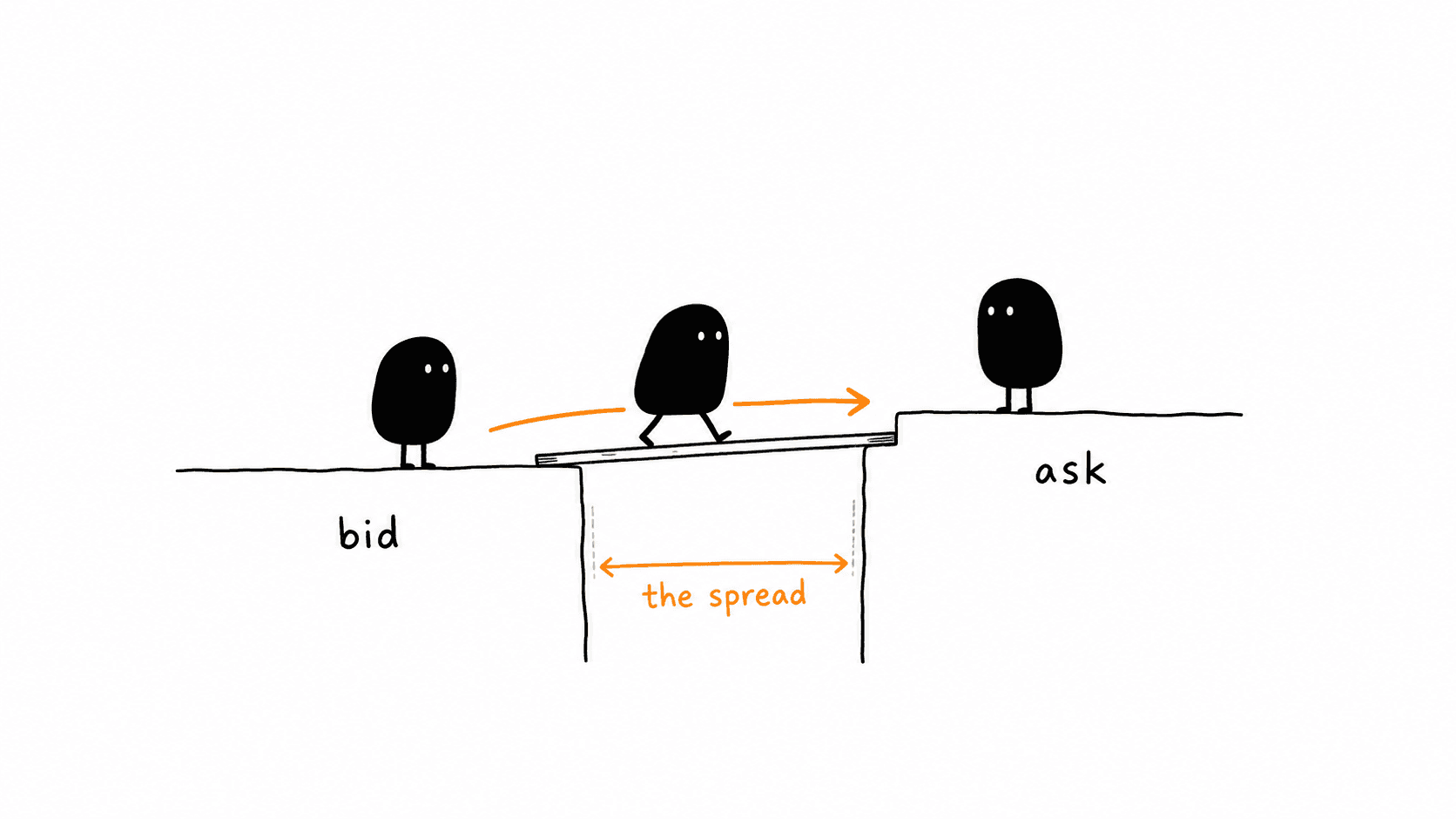
The difference between the highest price a buyer will pay (bid) and the lowest price a seller will accept (ask) for a security — a key measure of liquidity and an implicit trading cost.
Bid-Ask Spread · the mechanism
30 sec read
Read a two-sided quote, work out what a round trip costs you, and say why the spread is wide or narrow.
Where it comes up. A PM asks why the fill came in 21p worse than the screen showed, on a stock whose spread is 40p.
Read the quote
The bid is the most anyone is currently willing to pay; the offer, or ask, is the least anyone will accept. You buy at the offer and sell at the bid, always. The mid is the average of the two and is a convention, not a price you can trade at.
Price the round trip
Buying and immediately selling costs the full spread. Quote it as a percentage of the mid so instruments of different prices are comparable: spread ÷ mid.
Explain the width
A spread is the market maker’s compensation for two risks: inventory (the position moves against them before they can lay it off) and adverse selection (the person hitting them knows something). Thin volume, a pending announcement, a small-cap name and the minutes before a print all raise one or both, and all widen it.
Worked through
A stock quoted 249.80 bid / 250.20 offer.
- Spread
- 250.20 − 249.80 = 0.40
- Mid
- (250.20 + 249.80) ÷ 2 = 250.00
- Spread as a percentage of mid
- 0.40 ÷ 250.00 = 0.16%, or 16 basis points
Buy 10,000 shares and sell them back instantly and you are down £4,000 before commission. That is the cost of demanding immediacy twice.
Check yourselfTwo stocks both quote a 5p spread. One trades at £2, the other at £50. Which is more expensive to trade?
Answer once you have one →
The £2 stock, by a factor of twenty-five: 5p on a £2 mid is 250 basis points, against 10 basis points on £50. Spreads are only comparable in percentage terms, which is why they are quoted in basis points.
Be able to say this back next week
- Quoted the spread in basis points of the mid, not in pence
- Named both risks the spread pays for: inventory and adverse selection
- Said you buy at the offer and sell at the bid, and that the mid is not tradeable
Why Bid-Ask Spread matters in interviews
The spread is the first thing a trading interview tests, because it is where market structure, risk and cost meet. A candidate who can explain why a spread widens has said something about inventory risk, adverse selection and liquidity in one answer. It also matters well outside trading: the spread is the reason a fund’s paper return and its realised return differ, and the reason an illiquid holding is worth less than its last print.
How it works in practice
Spreads are quoted in basis points of the mid so that instruments at different price levels are comparable. A one-penny spread is enormous on a £2 stock and negligible on a £200 one. The most liquid large-cap equities trade inside a basis point or two; small caps run into the tens or hundreds; a corporate bond that trades a few times a month can quote a point or more wide, and the quote may not be firm in size.
The quoted spread understates the cost of a large order, because size rests away from the touch. What an execution desk measures instead is implementation shortfall: the difference between the price when the decision was made and the average price actually achieved, including the market impact of the order itself.
Spreads widen predictably: into an earnings release, around a central bank decision, in the first and last minutes of the session, and in any period when volatility rises. All four are the same mechanism: the chance that the next trade is against someone who knows more, or that the price moves before the maker can hedge.
Regulation and structure move spreads permanently. Decimalisation, the growth of electronic market making and competition between venues each compressed them. Fragmentation across venues, on the other hand, can make the consolidated touch look tighter than the size available at any one venue.
What candidates get wrong
- Comparing spreads in currency terms rather than basis points. Two 5p spreads are not the same cost if one stock trades at £2 and the other at £50.
- Treating the mid as a tradeable price. You buy at the offer and sell at the bid; the mid is a convention for marking positions, not a price anyone will give you.
- Assuming the quoted spread is what a large order pays. Depth, not the touch, determines the cost of size.
- Explaining the spread purely as the market maker’s profit. It is compensation for inventory risk and adverse selection; a maker who prices only for profit and not for informed flow goes out of business.
Bid-Ask Spread: frequently asked questions
What is the bid-ask spread?
The difference between the highest price a buyer is currently willing to pay (the bid) and the lowest price a seller will accept (the offer, or ask). You buy at the offer and sell at the bid, so the spread is the immediate cost of a round trip. It is normally quoted as a percentage of the mid price, in basis points, so instruments trading at different price levels can be compared.
Why do bid-ask spreads widen?
Because the risk of quoting has risen. A market maker faces two risks: the position moving against them before they can hedge it, and trading against someone who knows more than they do. Thinner volume, higher volatility, a pending announcement and a smaller, less-followed company all raise one or both, and all widen the spread. This is why spreads blow out in a crisis, when almost every trade carries information.
Is a tight spread the same as a liquid market?
Not on its own. A market can quote a penny wide with only a few hundred shares behind it, in which case anything larger than that walks up the book immediately. Liquidity has at least three dimensions: the spread, the depth available at and near the touch, and the speed with which the book refills after a trade. A tight quote in no size is a thin market wearing a good suit.
Keep reading
Interview guidesRelated Trading & Markets terms
Go further than reading
The written material is free. These are the ways to get it applied to your own work.
CV Review by a Human
Written margin-note feedback on structure, impact bullets and ATS-readability. Reviewed by Suro, not an AI score.
$25 48h turnaround
Cover Letter Review by a Human
Line-by-line review of argument, tailoring and tone, with a rewritten opening as a worked example.
$50 48h turnaround
L3VLUP Pro
The subscription: personalised alerts, Apply Packs, every answer marked, full history and the whole research library.
$25 /month
Browse the full glossary — 340 finance recruiting and technical terms, in plain English.